Showing posts with label AJS. Show all posts

June 3, 2013

VINTAGE RACING HEROES


The remains of an AJS K7 350cc OHC.  How do they look when finished?  Check here.
As generations of motorcycle collectors grow up, hoard machines, and finally pass to earth, the metal gems which so attracted them, their 'precious', those not ground to dust by the constant churn of oxidation, spousal disgust, familial ignorance, or simple forgetting, become available once again, emerging to light like long-abducted children, blinking at the glare of publicity and the passage of time, worse for their journey but still recognizable.
A Norton International M30, awaiting rescue
The least of these motorcycles never recovers from the neglect of decades, and carry on disintegrating in situ, or simply head to the skip.  The best of them - recognizable heroes, stiff and rusting in their armor - will be resurrected with the mingled application of time and treasure.
King of the auction, the stunning and very rare British Anzani 8-valve 1098cc  motor, ca.1924, waiting for a McEvoy chassis!
We may decry or delight in rising motorcycle values, depending on which side of the auction hammer we sit, but the simple truth is, the scent of lucre has drawn yet more intrigued collectors to the party, and all thoughts of economic uncertainty scatter before the undeniable reality of the Rare and Collectible.  The bottom line; if that pile of rust has a sexy history, it Will be restored.
The AJS K7, loosely assembled, and all the more evocative for being so
And so, I present a few long-lost Heroes, returned for the consideration of the motorcycling public, blinking in the light after a long confinement, waiting to become what they once were, and should be again.
The timing chest of the AJS K7, showing the Weller blade tensioner which made the simple chain-drive OHC system possible
These machines will be sold at the Bonhams 'Banbury Run' auction in Oxford on June 15th.  Oh, how I would love that Anzani 8-Valve motor!

July 4, 2012

THE CURSE OF THE MODERN MOTORCYCLE


Nicholas Biebuyck, who works at Bonhams, contributes his perspective on riding old, and new motorcycles...

Why are new bikes so boring?
The Biebuyck family 1928 AJS K8 'Big Port'
Thanks to undying enthusiasm, youth and (especially) my day job, I'm granted access to all sorts of cool places: afternoon tea in the Drivers Club at Goodwood Festival of Speed, bumping into Ago and King Kenny at Festival of 1000 Bikes, riding a wide selection of motorcycles of all vintages and types. In the past 4 weeks I've thrown a leg over a 1928 AJS 'K8'overhead valve 500cc flat-tanker (The superbike of the period), a 1971 Norton Commando 750 Roadster that my father bought new in Birmingham (again, The superbike of the period), and my 2003 BMW R1100S super tourer (well, not a superbike).   These rides have reinforced a feeling which has writhed inside me for some time: modern motorcycles are incredibly boring.

They certainly serve their purpose; if you want to go from A to B at maximum speed in relative safety and comfort, they're fine. And that's my point: they are...fine.  Not great, or fun, or riveting, or exhilarating, or particularly enjoyable, just...fine.
Nick riding the 'Big Port' on the Banbury Run this year
I compare riding a great motorcycle to riding a great horse; you understand each other, you want to go the same places, at the same speed, falling into corners at the same rate, you feel a harmony... in a way you simply cannot with a machine which gives you no feedback, and cannot be repaired at the side of the road.

On the 1928 AJS, you can [and must! - Ed.] hear every tiny noise from the valve train, you can see each drop of oil through the Pilgrim pump's sight glass, every undulation of the girder forks is visible,  and the hand change gear selection depends on 'feel' to avoid nasty noises.  It really didn't want to start this Spring, after a faultless performance on the Banbury Run last year, but there's a great sense of satisfaction starting a motorcycle with a lazy magneto, which has refused to rouse from your kicks the last 10 minutes. Especially in the pouring English rain...when you know there's still a great ride ahead.
The family 1971 Norton Commando
Although the Norton Commando was built 45 years later, the experience still is similar; a conversation between yourself and machine.  If you wring its neck past 5,000rpm, it wails, which you ignore at your own risk. The vibration at idle on the Commando is notorious but equally reassuring: if the engine doesn't look scarily ready to liberate itself from the frame at 1,000rpm, you know something is wrong...off balance crank? loose carb? badly adjusted isolastics? better check.  Yes, the right carb came loose while riding, but I knew it was coming because the stallion told me: it made a strange noise, followed by a loss of power. A quick glance down told be exactly what had happened, so I pulled over and fixed it.  Voilá.

Maybe I've become a Vintage/Classic Motorcycle Snob (a title I am content with), but it seems to me riders of new bikes are discouraged from understanding how an engine works, and are offered only utility from their motorcycle.  I struggle to believe that's all they want, given the number of new Royal Enfield Bullets and Triumph Bonnevilles on the road.  Until you ride something that really speaks to you, and takes you on a different kind of journey, how can you experience what's best about motorcycling?

c.2012 Nicholas Biebuyck

April 4, 2012

AJS K7 GLAMOUR SHOTS

Photographer Mark Fairhurst has a goal of making moto-portraits a quick and painless process, in situ and using mostly available light.  He recently shot this wonderfully patinated ca.1928 AJS K7 'cammy', one of a rare breed of overhead-camshaft bikes with Flat Tanks from the 1920s.

The legendary AJS pushrod-engined racers (below) had logged plenty of wins from their introduction in 1920, announcing the end of the sidevalve era at the 1921 Isle of Man Junior TT by taking 1,2,3, then winning the Senior TT with the same 350cc, ridden by Howard R. Davies. The 'Big Port' appeared in 1921, and gained a racing reputation for winning over the next 5 years. Given the rapid technological development of the day, with many factories introducing OHV engines with their racers and roadsters, the Big Port had a fine run of success, but competition was keen from Norton, Sunbeam, and Douglas with their own OHV racers.
The classic AJS 'Big Port' racer, ca.1925
By 1926, the writing was on the wall for the Big Port as a racing machine, as the new Velocette ohc 'K' racer made both fastest lap and a win in the Junior TT that year, with Alec Bennett piloting.  Dougal Marchant had also designed and ridden his Chater-Lea ohc, also a 350cc, at Brooklands in 1926, averaging over 100mph. 

AJS chief engineer Phil Walker was given the task of designing a new engine in late 1926, and chose the simplicity of a chain drive to the camshaft, which had been problematic in past attempts due to chain whip over a long run at engine speed, but the new, patented Weller chain tensioner kept things under control well enough for Aston Martin racers, as well as aero engines.  Shaft-and-bevel drive engines, as used by Chater-Lea and Velocette (and copied by Norton for the CS1 and Inter/Manx), were laborious to set up correctly, while the chain was simplicity itself, boding well for ease of manufacture and a lower sale price.
A proper oil pump kept the new motor well lubricated, and the engine was installed in a Big Port chassis.  It proved a success in 1927, taking 3rd in the Junior TT and wins in the Swiss, Belgian, and European GPs, with Jimmy Simpson their pace-setter.  Curiously, AJS chose to run their pushrod racers in the 1928 TT, making second place in the Senior TT, but for 1929 and beyond, they relied on the 'cammy' engines for racing, which led through the R7 racers of the 1930s, to the AJS 7R and Matchless G50 of the postwar era. 

January 17, 2012

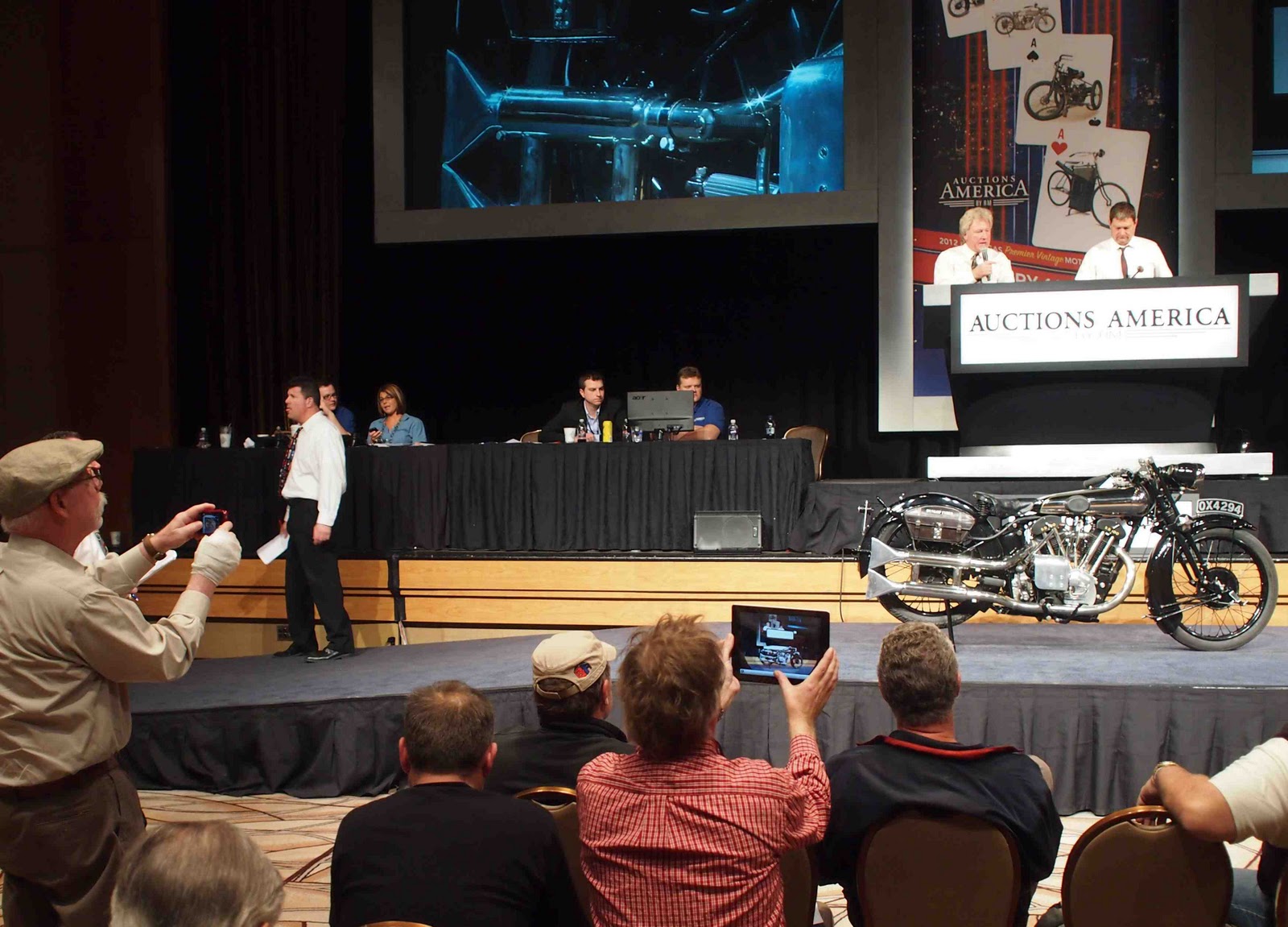
LAS VEGAS 2012: AUCTIONS AMERICA (RM)

Star of the show - star of the whole weekend actually - the 1895 Roper Steam Velocipede, one of the oldest motorcycles made in America, and Roper's second motorcycle; his first sits in the Smithsonian Museum, and is the oldest motorcycle in the world at 1867...a title shared with the Perraux steam cycle of France, built the same year.
The condition of the Roper is phenomenal.  While it has lost its asbestos cladding of the burner box, the motorcycle is otherwise complete and original, having passed from Roper's son to a museum, then a private owner.  Read the story here.
Alas, it went unsold at the auction; rumor has it that RM owns this machine, purchased for ~$500k. 
The 1928 Brough Superior SS100 'Dunlop' bike attracted a lot of interest, but not enough to meet reserve...
Another favorite; an original paint 1929 Cleveland 'Tornado' 4-cylinder, a real hotrod in the day, capable of over 100mph, and beloved of police forces lucky enough to use them!  Also unsold...
Racers!  A 1959 AJS 7R ($39,200) and cool Norton dustbin
Auctions America consigned a large Cotton collection, this one from 1928, with a 350cc Blackburne engine'...
The Blackburne engine in question...
...plus a groovy cast-aluminum 'Cotton' silencer.
Will six be enough for you, sir?  The Benelli 750 Sei..

This is not camera distortion; the largest tank ever on a '63 Cotton Conquest

1899 De Dion / Peugeot trike...just like they race them in England.  That's right; never let it be said valuable old bikes are left to languish in collections - the best owners use them! Alas, unsold...

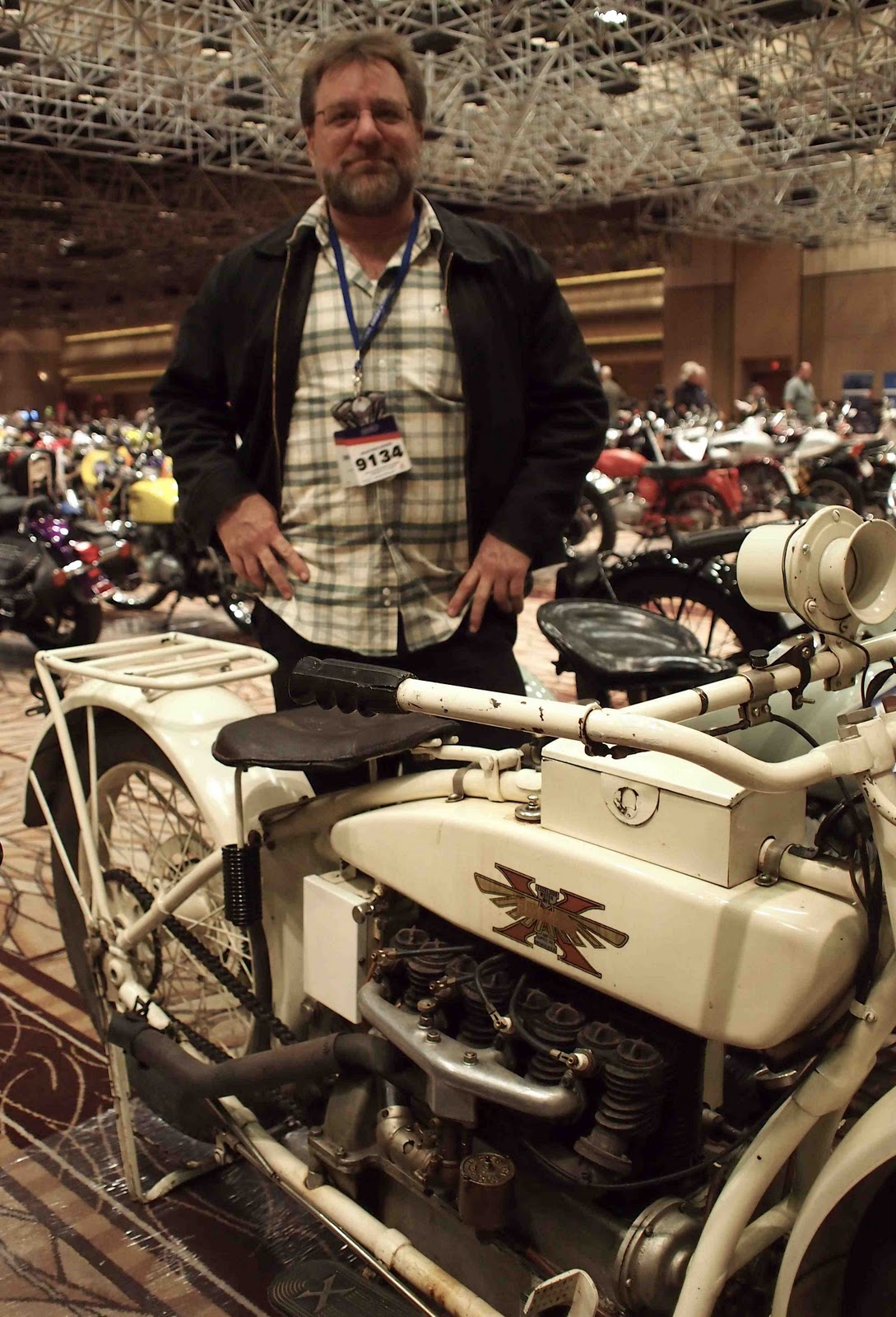
After purchase, Clay mentioned not liking the white of this Excelsior 4-cylinder..."But all the rest are blue!" I noted, and he felt better about his 'ghost' machine.

Great period details, great patina...

Auction America's Glenn Bator with an 1925 HD Board Track Racer...

The hall at the Rio casino, plenty spacious for 700 or so bikes...

Glorious 1913 Henderson Model B, an older restoration, with just enough use to give it an appealing patina.

Business end of a one-off jet bike, with an 317hp from its Allison turbine...

...this is not Allison Turbine...

Not enough dustbins these days; it was a pleasure to see this one ready for the track...

...and even better from this position!  Norton Manxes with such fairings are rare...

Sweet Rickman-Triumph, already in the van...

This ex-Steve McQueen, Von Dutch pinstriped Scott Squirrel is the sister of one which sold for $276,000 and sits on my 'Top 20' at Auction list...but this one failed to sell.


Winner - best transfer.  The Tehuelche 75cc ohc single-cylinder racer, from Argentina...

...with a lovely little engine, and a train of gears to the top.


A second Cleveland Tornado, this one restored.  Also failed to sell...

Greg recognized what was advertised as a '61 Triumph Bonneville, to be in reality a matching-numbers 1959 model, far rarer, and felt he got a bargain at $3500...

Vicki Smith with what she knows best; Ducatis

The 1902 (or maybe '04) Whitley of Coventry, the only known example, and in original paint.  Sold for $44,800

Two HD XR750 flat-trackers passed over the auction block...

Brett Robinson and the HD Panhead he felt was a bargain at $15,000...nice to see some fresh faces at Las Vegas!

October 27, 2011

NATIONAL MOTORCYCLE MUSEUM, ENGLAND


It's a pilgrimage to a messy shrine, the quintessential English shed grown wild with money, but the shed-mind remains, and the hallowed relics within overwhelm visitors in a nearly-stacked jumble.  The National Motorcycle Museum, phoenix risen from its own-damn-fault ashes, warehouse of glistening talismans, entombing shrine of Speed and a glorious, vanished industry.
Can you spot the...?  Neither can I.
Anyone who loves British motorcycles simply must make the trip to Birmingham, and spend a few hours soaking in the oily ambience...not that the pyramidal halls are anything but clean, and their 'NMM'-logo carpet well vac'd.  The bikes are fantastic, some of the most historic British prototypes, racers, and roadsters anywhere, a cornucopia really of the stuff you want to see, because the collection is just amazing.
Double Trouble Twins; Brough SS100 with JAP and MX engines
As with every time I've stopped in, the halls were nearly pedestrian-free when I visited this week, which is shameful for such a fantastic collection of machinery.  But, some basic rules of museum management are roundly ignored at the NMM... imagine if MOMA or the Tate stuffed every artwork in their collection to their walls in a vertical paintstorm, some pressed into corners, far away from their roped-off viewers. Things may have been done that way in the 1800s, but in the century since, Museum Studies has emerged as a discipline, and people get advanced college degrees in curation and display, studying ways for museums to attract viewers, and properly display their wares.
The Triumph zone was better accessible than other areas...
The NMM ignores most of this accumulated wisdom and pursues a used-moto-lot aesthetic, bikes jostling handlebars in long lines, with terrible sightlines and an utter impossibility to gain any detailed visual information from most of the displays.  A few sit on plinths, arranged so timing and primary sides can be examined close-up, but these are the exception, and if you're interested in figuring out how a 1908 Humber sorts out its magneto position, you'll have x-ray through several similar-era Triumphs and Rexes...in other words, impossible.
Collection as a numbers game; a lineup of the Norton rotary racers
Because the motorcycles themselves matter, it would be a revelation if we were actually able to see them in the round, well lit and fully visible.  I reckon that if the NMM held back part of its collection to give breathing space, and rotated themed 'blockbuster' exhibits like any other museum, visitors would find reasons to return, and the halls wouldn't be empty.  Better still, we'd be able to actually see these fantastic machines.
'Nero' and 'Super Nero' Vincent sprinters (one supercharged, one not)...would that I could have taken decent photos of the whole machines...
The incredible AJS ohc 1000cc v-twin one-off record breaker, which never really set records, but was stuck at around 130mph.  Note long induction tube from the blower, with blowoff valve at the top, and super large magnesium cam chain (and magneto chain) covers...
 Second primary chain drives the blower, atop the gearbox.  Bronze heads, hairpin valve springs, that crazy teardrop tank; simply stunning.
The placard claimed this BSA Rocket 3 with Gold Star bodywork was a suggestion from a US dealer for a potential big seller...I want one too!
Vincents don't look so bad now...this is the TRUE plumber's nightmare!
Bronze head on a semi-radial valve Rudge TT Replica racer
A short row of Brough Superiors of all varieties; an early MAG-engined Mk1 in front
Now those are Brooklands cans...on the back of a McEvoy 1000cc racer
Cutaway Triumph cylinder head
Italian sauce, English-style.  Lovely home-built 125cc dohc racer, the 'LCH', built by Leonard Clifford Harfield of Hampshire. Gear-driven double overhead camshafts, he based the engine on Rudge 250cc crankcases, and cast up the rest.  The engine would reliably rev to 11,000rpm, making 18hp, good enough for 95mph, and first privateer home in the 1957 Ultra-Lightweight TT.
The front brake of a 1950 Douglas 90+ racer
A much earlier Douglas, this is Freddie Dixon's 1928 Isle of Man TT racer, with wet sump under the engine, and an oil pressure gauge just behind the oil filler. He made 18th in the Junior TT that year, and fell off in the Senior (same bike apparently, with different cylinders and heads), injuring his hands and ending his bike racing career. Dixon, a gifted development engineer, switched to racing cars, and won the 1935 and '36 TT Auto races...the only man to have won TTs on two (1927 Junior TT), three (1923 Sidecar TT), and four wheels! 
The Brough Superior 'Dream', with 4-cylinder flat-4 engine, shaft drive, and groovy gold paint job.  Basically two Triumph twins on a common crankcase, it never ran properly as GB didn't have the cash for development work, and realized the market for such a machine was too small to justify the expense...
The 'Dream' cylinder head and exhaust manifold...grace in alloy.  The cylinder barrels were cast into the crankcases - one less joint to leak.  As far as I know, only Wooler and Brough attempted an ohv "H-four" motorcycle of this configuration.
New Imperial v-twin 500cc racer
Martynside v-twin, with their own-make engine
The McEvoy with big JAP KTOR racing engine, fed by a Binks 'Mousetrap' carb
Were they ever really like that?  Montgomery 4-pipe big Anzani twin with lots and lots of nickel...
Morgan 'Beetleback' Sports with big Matchless MX engine
Another failed Norton revival...the Nemesis, with special V8 engine
More successful were the Norton John Player-sponsored racers of the 1970s
Lovely old Norton 16H racer from the early 20s. Note the AMAC sports carb.
CTS (Chris Tattersal St.Annes) sits protected from English weather...
Lots of prototypes at NMM; this Royal Enfield triple is 3 cylinders from their 220cc two-strokes on a common crankcase
Another gem; the one-off Rudge 250cc v-twin prototype racer

Related Posts Plugin for WordPress, Blogger...
Twitter Delicious Facebook Digg Stumbleupon Favorites More

 
Design by Free WordPress Themes | Bloggerized by Lasantha - Premium Blogger Themes | Best WordPress Web Hosting