
 9:22 PM
 |
| Riding the Rocket; well, who's riding what here? |
It was Adam’s first job before the Fall -naming the animals- and he set a precedent, using distinct words for each beast, and not a numbering system. Without the pressure of God looking over their shoulders, motorcycle designers have often failed at Adam’s task, relying on a factory code to identify their work, and we are left with a century of Model 4s, TA3s, CB200s, and other, utterly forgettable ‘names’. Granted, the TR6 and GSXR earned their fame with a series of numbers and letters, which proves even nonsense syllables can gain the status of a proper name, just as with mantras used for meditation, which are sometimes intentionally meaningless - its their repetition which counts…and advertisers feel the same way. Just keep repeating the sound, until you buy one.
 |
| Well, you can't just call it the 'Really Fast'...better to Frenchify the name...'Rapide'! |
Motorcycle manufacturers figured out early that a memorable name carried a punch, and if a good name was matched by a good product, you’d scored a hit. This insured the health of the company, and continued employment of the designer giving names, no small matter in the lethal business of selling bikes. Automobile companies have whole departments conducting tests in rooms with one-way mirrors, measuring reactions of citizens to car names (they didn’t ask my opinion of Impreza, Aspire, or Celebrity…), but motorcycle companies rarely have that kind of budget, for testing or even advertising on a mass scale. Barring the Japanese boom years of the 1960s/70s, the general public has been spared interrupting their favorite TV soap opera with images of bikers having good, clean, dangerous fun.
 |
| The Velocette 'Thruxton'...well named, a strange mashup of 'thrust' and 'sex' and 'ton'...which is perfect. This is my green Thruxton, nicknamed 'Courgette', which I've owned for nearly 25 years, and was my sole transport at one point... |
Not just a Number: Here’s a parable on the value of a good name over a number. Valentine Page, Triumph’s head designer in the early 1930s, built a very well-engineered vertical twin Triumph 650cc, but you’ve never heard of it, because while beautifully made, he lacked the imagination to give it a name, opting instead for a designation; the ‘Model 6/1’. Plus, it was ugly. And Triumph nearly went bankrupt. Two years later (1936), an upstart megalomaniac named Edward Turner was hired away from Ariel to revive Triumph’s sagging sales. He tarted up Val Page’s bikes, and drew up cheaper, simpler, and lighter machines, which nonetheless were fast and fun. And he gave them names; Tiger 70, 80, 90, and the Speed Twin. Valentine Page’s vertical twin was solid and well-engineered, but that didn’t matter; it lacked a flashy paint job and shapely tinware, and wasn’t called a Tiger. Metaphorically, while Val Page was concerned with ‘rocking couples’, Edward Turner screwed his secretary on the desk.
 |
| Johnny Allen and company, at Bonneville, with the proto-Bonneville, a Triumph 6T with a twin-carb head |
It was that kind of world in the 1920s and 30s; Turner had effectively discovered the Language of Speed, and backed it up with just enough competent engineering to make the names stick, forever. He knew it, too; his principal draftsman Jack Wickes (the man assigned to refine Turner’s sketches, who some feel deserves as much credit as ET for Triumph’s designs) recalled in much later interviews; ‘I told E.T. the steering head angle on the Speed Twin was wrong, and the bike would handle much better if we steepened the forks. His response was ‘the lines are right – moving the wheel closer to the engine would ruin the looks’. This may have been the reason why Turner, after he took over the helm of Triumph as Director, refused to support a factory racing department or even an official racing team until the mid 1960s (after he'd retired). He’d seen enough snapped crankshafts, broken cylinder barrel flanges, and cracked frames when his Tigers were ridden hard at Brooklands just before WW2, and wasn’t of the opinion that ‘racing improves the breed’. At least, not the brood he sired… While visiting America in the 1950s, Turner spectated at the Big Bear Enduro, and was treated to the death of a Triumph rider when his frame broke in two. Then Triumph introduced a stronger frame. The Triumph strategy was to let dealers play the racing game, and improve the models via their feedback; racing on the cheap.
 |
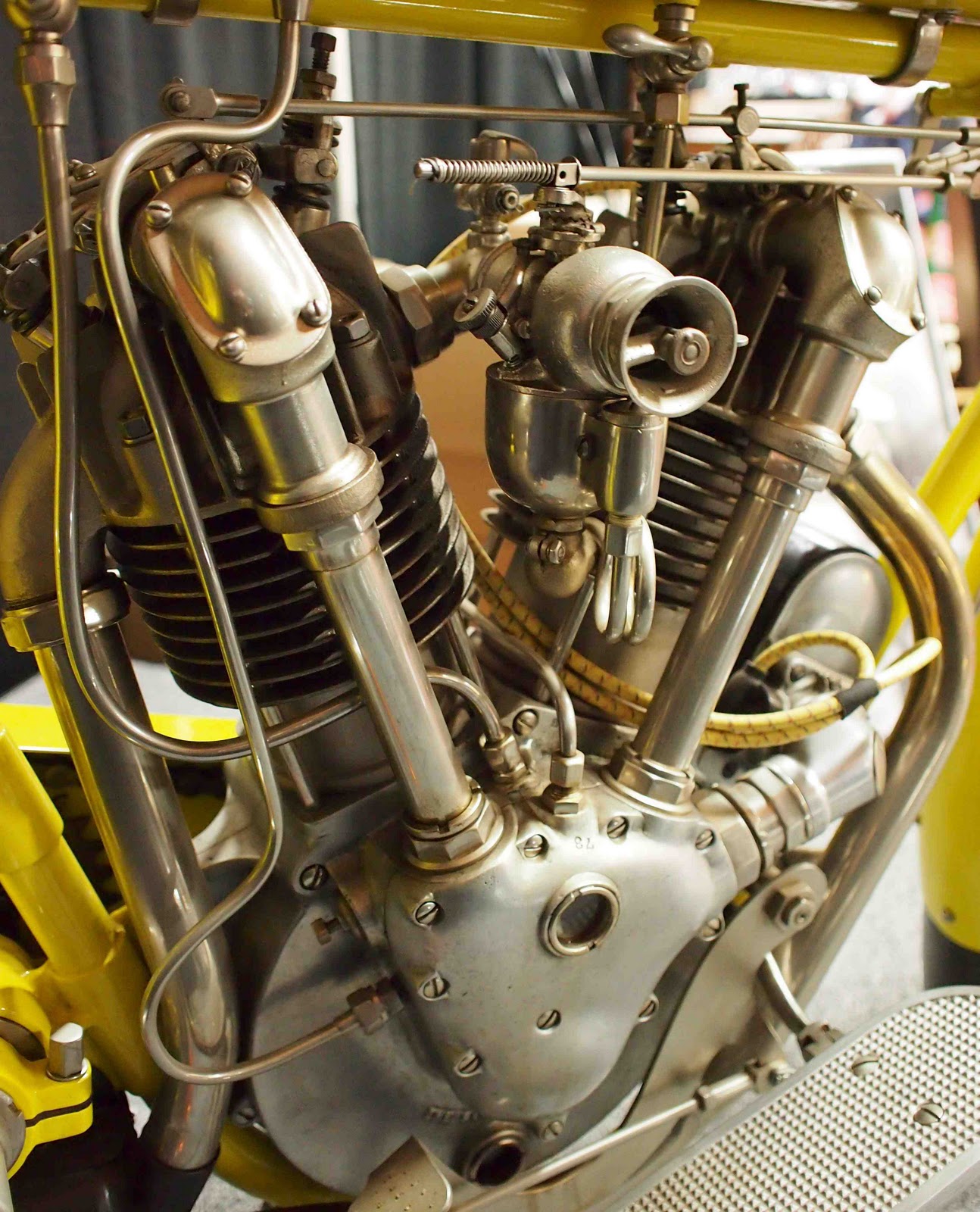
| The 'Scout' became the 'Daytona Scout' when tweaked for racing at the famous Florida beach. You could also buy 'Bonneville' cams for your Chief... |
After WW2, more Speed Twins, Thunderbirds, and Tigers gave way to a marvelous stroke of inspiration, when a laconic Texan named JohnnyAllen stuffed a twin-carb Triumph 6T motor into a fiberglass cigar, launching that missile over a dry salt lake in Utah at 214mph in 1956. A lightbulb in Edward Turner’s head clicked, and the ‘Bonneville’ was born, which drew the ire of GM's lawyers (who introduced their own Bonnie in ’57 – called the ‘Parisienne’ in Canada…WTF), and birthed a legend. And what a name; Bonneville is still the hallowed chapel of Speed, every red-blooded biker on earth wants to visit the most inhospitable place imaginable; absolutely nothing lives there, the landscape is pure salt, there aren’t even flies out there in the middle of pure white nothingness. But, there’s also nothing in the way; just point and shoot.
 |
| Full points to the Collier brothers for coming up with 'Matchless'. Followed up in the 1950s with the 'Clubman' models, which didn't imply a charitable society, but the potential for racetrack fun |
Motorcycles with place names are typically associated with races; if you won at a track, nothing stopped you slapping a sticker of Le Mans, Daytona, the Manx, or Silverstone on your oil tank. Sometimes there was duplication, as with the ‘Thruxton’; nowadays, you can buy a new Triumph with that name, but nobody remembers the bleak, ex-military airfield in southern England on which hay bales outlined a circuit, and long-distance races were held in the 1960s. Velocette did well there, and named their last production racer after the track; their Thruxton is rightly revered as, perhaps, the ultimate production café racer of the 1960s. But that was the 500cc class; at the same time, Triumph was winning in the under-700cc class, and they put out a racer too – the ‘Thruxton’ (they made ~60) from which your brand new Triumph has stolen its name. Why do re-heats of a good name always turn out fatter and slower than the original?
 |
| The original BSA M24 'Gold Star', named for the little brass medal given competitors at Brooklands who'd managed a 100mph lap during a race. Coveted thing, that medal. |
The curious neuro-mechanism pumping a chemical cocktail to our bloodstream as a word-response has long been understood by political speechwriters and product hawkers, since the power of speech first developed. A potential customer may never have been to a race at LeMans, but the word acts like a mantra of Speed and excitement; repeated often enough (like Goebbel’s lie which becomes true), that mantra has a fixed association. LeMans = Speed! This is the power of advertising (and other forms of progaganda), but the roots of our response are Very Old. Goebbels didn’t invent advertising, not even advertisers invented the mesmerizing attraction of a good name or catchy line. Going back to Adam, words are the very thing which separates us from animals, and language has replaced inborn instinct. Animals don’t need to be told what to do, they are born knowing, are hard wired to be themselves, and survive. Humans need language and repeated demonstration in their years-long struggle to become self-sufficient. These instructions for life are hidden in stories passed down for thousands of years; the accumulation of these stories is called culture. As our very survival has long depended on story/instruction, we are vulnerable by our very nature to the lures of advertsing copy. Its how we’re built - we respond to stories. The simplest form of a story is a single word; a name so packed with associations and ‘subtext’ that you’ve said a mouthful in one or two syllables. LeMans. Bonneville. (Auschwitz). Guide that association with a little visual imagery in advertising, and you’ve created a brand.
 |
| If you're going to harness the wind, you might as well go all the way, and make it a Cyclone. And they were fast, until they broke. |
Triumph’s Turner didn’t invent the sexy motorcycle tag, we have to jog further back in time to the establishment of proper motorcycle race tracks by 1907 to fire the buying public’s imagination. By 1912, ‘TT Replicas’ appeared in catalogs, promising speed beyond imagining to the average Joe. These were utterly impractical machines, typically without suspension or gears or a clutch, but a determined rider could use them on public roads for maximum bragging points. In 1915 Norton created the ‘Brooklands Special’ for racing, and by gosh, the next year they offered the ‘Brooklands Road Special’, proving that moto-poseurs have been good business for a century.
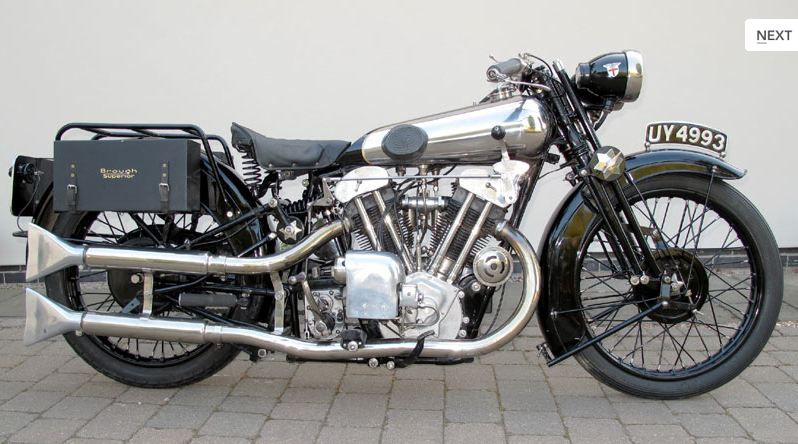
The first true master of advertising copy - the catchy phrase, the sexy moniker - was George Brough. A born sloganeer and braggart, his company claimed ‘Superiority’, and his models, like ‘Super Sports 80’ (SS80) and ‘SS100’, promised speed in their very names. In 1925, 100mph –guaranteed- from a production bike was radical, and flaunting the top speed in the bike’s name would be imitated for decades, especially by Triumph, whose bikes grew faster on your tongue, from the Tiger 70 in 1935 all the way to the T160 three-cylinder in 1975. Nowadays, motorcycles are so illegally fast, top speeds are whispered behind hands.
 |
| The SS100 Brough Superior; if George Brough hadn't delivered on his promises, he'd have looked the fool, but he did what he claimed, and doggedly pursued the 'world's fastest' title for nearly 30 years |
Animals are faster than people: Tigers, Cheetahs, and Hawks - the terrifying creatures of our distant past, the ones which snapped the necks of slow runners in our first million years of upright bipedalism, hold a special place in our hearts. With several hundred thousand years of Fear lodged in our genetic memory, every culture treats predators with a godlike respect. We envy their strength and violence, and are awestruck by their exquisite, functional beauty. The only surprise regarding predators and the motorcycle industry is how long it took to make the associative leap from four legs to two wheels.
 |
| Sportsters and Sprints; H-D tended to give cheeky names to its smaller products |
Then again, until the 1920s (that’s 30 years into the development of a proper motorcycle industry), motorcycles were basically crap. The lure of Speed was clear from the first wobbling miles of powered riding, but the pursuit of speed’s pleasures was often frustrating. When bikes became reliably fast, didn’t catch fire, skid uncontrollably, and handle like drunken camels, they changed radically in appearance as well. Bikes built before the mid-1920s looked like picket fences stuck with a mailbox and a pineapple. The slow progress to move engines lower (and drop the center of gravity) coincided with smaller wheels, shorter frames, and heavier proportions of components. The best designers of the 1920s, men like George Brough and Max Fritz, were able to gracefully integrate these tendencies to shrink motorcycles into compact and powerful tools.
 |
| Lots of British companies sold 'Isle of Man TT' models, or simply 'TT Replicas', or in the case of Norton, simply the 'Manx' |
The evolution of a completely new motorcycle aesthetic in the mid-1920s brought a gradual evolution of a new metaphor; the two-wheeled animal. Whether the new motorcycle shapes were a case of Biomimicry (using nature’s solutions to inform design), or an inevitable response to the natural forces a motorcycle must overcome (friction, gravity, wind, inertia), the result was a machine we humans could relate to genetically. With a clear ‘skeleton’ and musculature of engine and gearbox, the best-designed motorcycles had a harmony of form and grace of line which triggers something very old in our brains; we respond to these shapes with much the same feelings evoked while watching a tiger strut or a falcon shriek through the sky. We feel awe at the beauty and implied power of the beast / motorcycle, a combination of feminine grace and masculine power.
Lose that masculine/feminine balance, and you’re left with the also-rans of the moto world, the forgotten models, which only anoraks like me care about. Why bother with the ugly Tina scooter when you could fill your dreams with a Tiger 100? Why remember the spindly Sunbeam Model 5 Light Tourist, when the ‘TT’ 90 was a perfect object? Who gives a shit about the Brough Superior '680 Sidevalve' when George Brough could have retired in 1925 after penning the SS100, and be remembered forever?
We remember the ‘animal’ bikes when the pairing is successful, the Tigers and Capriolos and Hawks, but a good name doesn’t guarantee success. The Tigress scooter was a dismal failure, as was the Harley XLCR ('Excelsior!'); the motorcycle Hall of Fame has a basement stacked with rusting also-rans, and for every Thruxton, a dozen forgotten models languish in the shadows. Even the cosmic power of the Word has its limits.
 |
| Can't resist adding another 'TT' Model...as I have exactly this Sunbeam! Such a thing of beauty; light and fleet and fit as a greyhound |
[This article originally appeared in French Café Racers magazine, in their second 'Speed' special issue. Editor Bertrand Bussillet does a beautiful job with the magazine; my only regret - its not in English. Bertrand is a trooper to regularly translate my articles; merci beaucoup mon amis!]