Showing posts with label Historic Riders. Show all posts

December 10, 2012

BMW 'KOMPRESSOR' FOR SALE AT VEGAS

[I'm rarely asked to write catalog copy for Bonhams, but was happy to oblige in the case of this exceptional supercharged BMW, an RS255 'special' built of genuine racing parts supplied by BMW and others, assembled by legendary GP pilot Walter Zeller with BMW mechanic Gustl Lachermair, to campaign in Vintage events.  The following is my description for the upcoming Bonhams sale in Las Vegas]
There is no question the BMW RS255 deserves a place at the very pinnacle of motorcycling history. While the German marque is admired throughout the world for its decades of competent, comfortable, and stylish motorcycling, there was a brief moment when it stood atop the world of road racing as well, having honed 15 years’ development of supercharged Rennsport machines into a thoroughly efficient, reliable, light, and devastatingly fast machine. The late 1930s was a Golden Age of Grand Prix racing, with the motorcycle factories of Europe clashing on newly-built, high-speed racing tracks with supercharged racers of multiple cylinders. Stalwarts of single-cylinder, overhead camshaft development – Norton and Velocette especially – had honed their light and reliable racers since the mid-1920s, with great success, creating the benchmark for an all-around excellent racing motorcycle, which combined light weight, good handling, high speed, and durability for the long-distance races. An amateur rider of great skill could, and often did, win a place in International racing with a machine purchased from these factories. But the ‘Works’ jobs were always that bit faster, and by the mid-1930s, what the factories created for their teams became a completely different animal from what even a favored rider could hope to purchase. And in truth, over-the-counter racers still held a good chance for a win or place, as the big factories were really stretching the limits of technology and metallurgy while testing scientific theories of combustion, supercharging, and aerodynamics.
The RS255 supercharged motor, with Kompressor integrated to the front of the crankcase, and compact DOHC cylinder heads
BMW were among the first motorcycle manufacturers to experiment with forced induction, waiting a mere two years after the marque’s debut (in 1923) to bolt a supercharger to their overhead-valve racing machines.  Perhaps because of BMW’s deep connections with aero engine and auto GP practice, their racing motorcycles were subject to continuous development with ‘blowers’, initially with mixed success in road racing, but which made great account of themselves in the arena of Land Speed Record-breaking.   The World’s Fastest title had, since 1924, been held exclusively by large-capacity JAP-powered English v-twins (installed in Zenith, OEC or Brough Superior chassis), until BMW in 1930 inserted special, Rennsports ‘Kompressors’ into the mix, always with the brave Ernst Henne at the helm.  From that date forward, BMW alternated mostly with larger-capacity English v-twins for the top speed stakes, although a rival Italian marque, Gilera, took top honors in 1937(170.27mph), before BMW snatched the title again later that year (173.68mph),which it retained until 1951.
Ernst Henne with the supercharged BMW WR750 which took many World Speed Records (this from his successful 168.92mph run in 1936)
From that first World’s Fastest title in 1930, considerable development was required before the BMW chassis could compete on even terms with the fleet and nimble English single-cylinder racers.  Great strides forward came in 1935, with the introduction of a recognizably modern telescopic front fork, and the integration of the supercharger at the front of the engine, rather than atop the gearbox as previously.  That blower now sent pressurized air past valves operated by twin overhead camshafts, encased in a remarkably tidy and compact magnesium cylinder head cover. By 1937 BMWs had springing at the rear as well, using a coil-sprung plunger system, with an additional friction damper for the racers to keep the undamped bounce under control.  As the engine dep’t found increasing power, a strict focus on weight control began to pay dividends in handling and acceleration.  The extensive use of magnesium for engine castings and wheel hubs was combined with an ultralight, lugless frame built from lightweight, tapered tubing; elegant, very light, and very strong.   The result of this continual development and improvement was the RS255, which won both the German and European championships in 1938.  A final prize eluded BMW’s grasp, though, as the globe’s attention focused on the Isle of Man TT as the ‘ultimate’ road race, and BMW could only manage 5th spot at the TT in ’38, with English rider Jock West aboard.
The famous photograph of Georg Meier flying over Ballaugh Bridge in the 1939 Isle of Man TT
The RS255 had been lightened, tuned, and honed into an exquisite racing motorcycle.  It was faster than all its rivals, barring those (AJS, Gilera) with twice as many supercharged cylinders, yet managed to be lightest of all the 500cc Grand Prix racers, fully 30lbs less than its chief rival, the now double-overhead camshaft Norton, which also had its own extensive use of magnesium casings and full springing front and rear.  The two principal advantages of the English marques became the reliability of their engines, and the excellence of their riders.  BMW had an ace up its sleeve in the rider department, as a stout-hearted policeman named Georg Meier had rocketed in a mere two years to the top of the road racing game, after being talent-spotted during a brief off-road motorcycle racing career.  BMW team-mates Jock West and Karl Gall were excellent riders, but lacked the special qualities required of a racing Immortal.  
Jock West aboard the 1937 version of the BMW Kompressor, which used a chassis similar to the BMW R5; a rigid-frame of lightweight tubing, the BMW telefork, full-width hubs, and 'that' motor
Meier wasn’t invincible during the 1939 Grand Prix season, as the four-cylinder, double-overhead camshaft, water-cooled Gilera ‘Rondine’ racked up racing points by sheer blazing speed on the ultra-fast tracks of Europe, winning the European Championship that year.  But the Isle of Man TT still beckoned, which required excellent handling, and a superior rider, beyond mere top speed.  Arriving on the Island early to exploit 14 full days of race practice, the BMW team desperately wanted to prove the superiority of their machines, and pushed hard; member Karl Gall paid with his life, crashing heavily after the notorious ‘leap’ at Ballaugh Bridge.   Despite the loss of their team-mate, Meier and West dominated the Senior TT, with Meier especially smashing lap records from a standing start, and carrying on breaking lap times till the very end, when he became the first non-British rider to win the world’s most difficult road race*.  His victory ensured the RS255’s, and his own, enduring legend.
Lucky bugger Nick Smith of Bonhams aboard the RS255 Kompressor at Willow Springs raceway
After WW2, with Germany, and supercharging, banned from International racing, some ‘blown’ BMW racers continued to circulate in the domestic championships, but complete, and functional, RS255s were always extremely rare.  With the rise of Vintage racing and heritage parades around the world during the 1970s, no example of BMW’s ‘Kompressor’ was available for public demonstration (Meier’s alleged ’39 TT winner sat in boxes in the USA), so former BMW factory racer Walter Zeller asked BMW to parade Georg Meier’s 1950-era RS255, which sat on display at the BMW Museum in Munich.  BMW said ‘no’, but Zeller was persistent in his desire to show the legendary machine on the track; he knew the BMW factory still possessed a considerable pile of early racing parts, and in 1980 he began assembly of a 1951 Rennsport ‘plunger’ frame with a genuine 1939 RS255 engine. Gustl Lachermair, the BMW engineer who was responsible for servicing racing engines all through the 1950s-70s (and who rebuilt almost all RS engines after retiring from the factory), built the engine to 1949/50 specification, with a bigger supercharger than used in ‘39. The 1951 chassis has a strengthened frame, and the leading axle teleforks are very similar to the type used by BMW in 1949-50.  Zeller modified the front brake for twin-leading shoe action, and used clip-ons instead of the ‘39s flat aluminum handlebars.  The rear wheel was built with a 19” rim instead of 20”, as no new tires of that size were available.
From Classic Bike magazine, June 1985; Walter Zeller, Gustl Lachermair, and Stefan Knittel discuss Zeller's RS54 and RS255 Kompressor
Zeller and Lachermair used mostly original, factory racing components, which they accumulated from BMW factory stock or private contacts. BMW understood this machine to be Walter Zeller’s private project, and gave him the parts, which might seem less remarkable today, knowing the BMW factory had previously presented Zeller with a factory-built, road-going supercharged ‘special’ in appreciation for his 2nd place in the 1956 Grand Prix World Championship. In the end Walter Zeller became the official owner of the completed motorcycle. The BMW factory kept no records of racing engine and frame numbers from the prewar era, and there exists no related information correlating to race entries, riders or results. It is therefore impossible to state with certainty the race history of the engine or chassis of this motorcycle, only that the components are nearly all genuine BMW ‘factory’ racing parts, assembled by two legendary figures in BMW history - racing champion Walter Zeller, and engine builder Gustl Lachermair - and paraded by Zeller in Vintage events from the 1980s.

(*The Senior TT.  Of course, Omobono Tenni was the first 'foreign' rider to win a TT)

July 9, 2012

BROOKLANDS GEMS AT STAFFORD

The Brooklands 'Gold Star' winning Grindlay-Peerless 'Bill Lacey Replica'
A pair of well-known and substantially documented ex-Brooklands racers are coming under the hammer at Stafford in October.  Bonhams' motorcycle specialist Ben Walker describes the 1930 Velocette KTT MkI and 1928 Grindlay-Peerless 'Bill Lacey Replica' as having solid gold provenance, of which he's 'particularly excited about'.
The ex-Jeff Clew, ex-HC Lamacraft, ex-AC Perryman Velocette KTT Mk1...whose name will be next on this list of esteemed owners?
The Velo KTT Mk1 is from the estate of late lamented moto-writer Jeff Clew, and once belonged to HC Lamacraft, and AC Perryman, who included many photographs of this machine in action in his excellent book, 'A Clubman at Brooklands'.   The machine was also raced at the Manx Grand Prix.  It's believed Clew purchased the Velo from Les Wise, the husband of Pat Wise (famous as four-time World Sidecar Champion Eric Oliver's 'monkey').
HC Lamacraft on is mkIV Velocette KTT on the Isle of Man
Perryman gives extensive time in 'A Clubman at Brooklands' discussing the Velocette's merits, and the KTT is known to have launched the racing careers of dozens of riders in the late 1920s and 30s, and several featured riders on The Vintagent won their Gold Stars at Brooklands while riding them.  As their swansong before the Veloce factory gave up racing, the factory race dep't won the 350cc World Championship in 1949 and 1950, with Freddie Frith and Bob Foster the respective winners.
CWG 'Bill' Lacey on Aug 1, 1928, after setting a World's Record at 103mph for one hour on his 498cc Grindlay-Peerless JAP
The Grindlay Peerless will be familiar to anyone who's visited the Brooklands Museum, as the bike has been on display there for many years. The 'Bill Lacey Replica' bit requires explanation: in 1928, Motor Cycle magazine offered a prize to the first rider to cover 100 miles in an hour, on British soil. Veteran Brooklands man CWG 'Bill' Lacey, who was tuning (in concert with legend Bert leVack) JAP engines and installing them in immaculate, nickel-plated Grindlay-Peerless chassis at the time, took a crack at the prize and did 103 miles and 532 yard in the hour.  Grindlay-Peerless were wise enough to offer replicas, although they must have been ferociously expensive with all that plating and a specially tuned engine; only a few (6?) were sold.  Edward James 'Boy' Tubb purchased this machine in 1936, but found performance definitely not to Gold Star standards, as he could not better a 90mph lap.  Handing the engine to ECE 'Barry' Baragwanath for tuning (which cost £12.10) gave the proper speed, and Tubb won his Gold Star at 102mph.
Drive side of the ex-Tubb Gold Star winning Grindlay Peerless at the Brooklands Museum
Visiting the family to arrange the sale is a fantastic story, which I'll let Ben Walker relate:
"I had a phone call from a Mr Tubb about a year and half ago telling me about his father’s Grindlay Peerless. As soon as they told me it was the one in the Brooklands Museum I knew the machine immediately. I went down to meet him and his brother at the garage their father (and, I believe, Grandfather) ran. They invited me to see their father’s personal garage - which was largely untouched since he’d passed away. On the shelf were a couple of dusty black binders. Inside the binders were pre-war Brooklands programmes - for the events he’d raced the Grindlay at! Complete with, in some cases, the entrance ticket and paddock pass. Then they handed me the below....can you imagine my reaction??"
A genuine Brooklands 'Gold Star' won on the Grindlay-Peerless by EJ 'Boy' Tubb, for completing a racing lat at Brooklands at over 100mph average speed.  
"After the war the G-P was sprinted (images of EJ Tubb with John Griffiths and Francis Williams and their mounts). At some point it we believe it was detuned to allow the owner to continue parading the machine into his dotage (it’s lost its twin port head for example). I don’t know yet whether it was before his death or after his death that the machine went on display at Brooklands...but you can imagine the guilt I felt removing it. In all fairness the guys at Brooklands (with whom I have a great relationship) were very understanding. Hopefully whoever buys the machine would consider putting it back in the Museum...I would."

June 29, 2012

ATLANTA'S 'BLACK STREAKS'

Contributor David LaMar Morrill recently brought my attention to the remarkable and nearly forgotten story of Afro-American Board Track Racers during the 'Teens, deep in the American South.  The prospect of turning up some new motorcycle history is deeply exciting, and I encouraged David to write up an article.  After researching this obscure tale, he delivers the story here:

The 'Other' Harley and Indian War
Two of Atlanta's 'Black Streaks' astride their Indian board track racers, in 1919
Beginning in the mid-Teens, factory racing teams from both Indian and Harley-Davidson fought a hard battle for dominance on the board and dirt tracks around the country.  Great riders like Gene Walker, Shrimp Burns, Otto Walker, and many others made their names riding for either the Indian 'Wigwam' or the Harley 'Wrecking Crew'. The bikes they rode were little more than bicycles, with powerful V twin engines, and no brakes. Motorcycle racing was a major spectator sport and drew tens of thousands of spectators across the country. 

In Atlanta, another group of racers sought fame and fortune, whose story today is virtually unknown; these black riders had colorful nicknames like Hall “Demon Wade” Ware, Horace “Midnight” Blanton, and “Bones the Outlaw,” who raced each other at Atlanta’s Lakewood Speedway from 1913 to 1924. They didn't have the latest factory racing bikes, and their racers were often cobbled together with obsolete parts from the scrap piles of the local Harley and Indian dealers. They were known as Atlanta’s 'Black Streaks' and while their races were covered by the national motorcycle press, the articles reflected the racial prejudice of the day, with a 1919 Motorcycling and Bicycling article titled “When Dinge Met Dinge in Georgia"; the text was even worse.
Lining up for the 1924 'Championship' race at Lakewood Speedway
 In 1913, black riders gathered at the Atlanta Motordrome, a two mile oval Board Track, to compete in a motorcycle race held for black racers.  This appears to be the only race of it's kind held at the Motordrome. No account of the race, or it's participants has been found. The only mention is found in a November 1913 article in Motorcycling and Bicycling magazine, announcing the Atlanta Motordrome's pending bankruptcy. The article stated the Bonita Theater Company of Atlanta, owners of the Motordrome, had filed for bankruptcy. It further stated:
This Motordrome earned an unsavory reputation by pulling off a race with negro riders, in defiance of F.A.M. regulations, thereby becoming outlawed as long as the present management exists.” As a result of the bankruptcy, the Motordrome closed.  It was later torn down, and is the current site of Atlanta's Hartsfield-Jackson International Airport.
Hall Ware, who rode as 'Demon Wade', aboard his Indian board track racer.  'The Grand Cullud Motorciccle Champeen of Jawja' [sic], as noted in a contemporary report.
Racing shifted to Atlanta's Lakewood Speedway in 1918, a one-mile dirt oval, and in June that year was held the “Grand Colored Motorcycle Championship Race.” The event drew large crowds from Atlanta’s black community, and wagers were often placed on the favorites. While the Harley and Indian factories had no involvement in these races, the local Harley and Indian dealers gave limited assistance to their chosen racers. They also  placed large wagers between themselves on the outcome of the race. In June of 1918 South Carolina racer Tom Reese, who called himself the “Champion of South Carolina”, arrived in Atlanta for the Championship. Reese’s manager began to brag that Reese could beat any Atlanta rider and was prepared to place a large cash wager to back up his claim. At the local Indian dealer, Hal “Demon Wade” Ware saw an opportunity. Already an accomplished local racer, Ware worked for the dealer as a mechanic. He convinced his boss, Nemo Lancaster, to lend him a competitive bike to race against Reese. While Lancaster recognized Ware’s talent, the rumor was he had a very large side bet with Reese’s manager. At the start of the race, Reese on a Harley-Davidson jumped out to an early lead. Reese’s manager was already looking forward to winning the wager. Ware, on the loaned Indian, soon caught the Carolina Champion, and passed him winning the race. Ware claimed the $150 first prize, and Lancaster collected on large side bet with Reese’s manager.
Horace 'Midnight' Blanton
The August 1919 race was another hard-fought battle, this time between 'Demon' Wade and 'Bones the Outlaw'. 'Midnight' Blanton won several of the preliminary races, and had a shot at winning the championship race. The night before the race, Atlanta board track racer Hammond Springs (who was white) helped Wade install Springs’ new Indian racing engine into Wade’s older Indian frame. The competitive engine allowed Wade the edge he needed to leave Blanton in his dust. On the final lap, he and Bones the Outlaw crossed the line in a tie. This required a rematch, which Wade won hands down, claiming the 1919 championship. The race for third place was battled by Sidney Donaldson (Indian) and Ernest Cox (HD).

Eventually, 'Bones the Outlaw' switched to racing automobiles, and 'Demon' Wade had sold his machine and moved north. For the 1924 races, 'Bones the Outlaw' made a demonstration run in his racing car, blasted around the dirt oval and putting on quite a show, narrowly avoiding a crash several times. In the motorcycle race, Horace Blanton had less competition, his two chief rivals having moved on, while his new rival proved to be Joe 'Read 'em and Weep' Reeder, riding a stock Indian Chief (probably his daily rider).  Blanton easily claimed the championship over a field of less experienced riders. 
Atlanta's Lakewood Speedway, the 'Indianapolis of the South', as seen in the film 'Smokey and the Bandit'; the track was used until 1979
In November of 1924, the owners of the Lakewood Speedway (the Bonita Theater Company) filed for bankruptcy, with C.F. Morris the receiver. An article announcing the bankruptcy stated:“This motordrome which earned an unsavory reputation by pulling off a race with negro riders, in defiance of F.A.M. regulations, thereby becoming outlawed as long as the present management exists.”  With the track’s bankruptcy, the races came to an end.  Still, for eight years a group of black motorcycle racers created a unique story in the 'Jim Crow' South, and had a moment in the limelight.
A 1919 article in 'Motorcycling and Bicycling' magazine.  The racist language recalls the abuse heaped on 1899 World Champion bicyclist Marshall 'Major' Taylor throughout his career.  For insight, I highly recommend any of his biographies.

 Author’s Note: This article is based on period articles from the collection of author Stephen Wright of Morro Bay, CA. Without his assistance, this article would not have been possible.  c.2012 David Morrill 
[Editor's note:  Stephen Wright is author of the remarkable 'American Racer' books, essential reading!]

May 18, 2012

GENE WALKER, BOARD TRACK RACER


[David Morrill of Sylacauga, Alabama, submitted this story of Gene Walker, a legendary board track competitor for Indian in the 'Teens.  Morrill is a retired Orlando police officer, who rode five years as a motorcycle cop, and also raced motorcycles.  For more on Board Track racing, click here for my earlier article.]
Gene Walker on his Indian Powerplus, Daytona Beach Florida, 1920 (Don Emde collection)
Birmingham’s historic Elmwood Cemetery is the final resting place of several Alabama sports legends, from Paul “Bear” Bryant to Dixie Walker. There is another legend buried there who is all but unknown in his own home town. During his career, his exploits made the sports pages of the major newspapers, and his untimely death was mourned by fans nationwide. In the northeast corner of the cemetery is a simple marble headstone that reads: Gene Walker 1893-1924.
John Eugene “Gene” Walker got his first motorcycle in 1910 and rode it to deliver mail for the local post office. But in 1912, the Alabama State Fair sponsored a motorcycle race at the Birmingham Fairgrounds Raceway, and it was Walker who won the final race of the day. Bob Stuibbs, a local Indian Motorcycles dealer, took note, soon putting Walker on a new Indian eight-valve racer and racing him out of his downtown Birmingham dealership.
Birmingham Fairgrounds Raceway 1913/14, O.H. Hunt photograph (Johnny Whitsett Collection)
Big bikes with no brakes
Early racing motorcycles were little more than large bicycles with large powerful engines–and no brakes. They could reach speeds of 90 m.p.h. on the tracks of the day, and racing them was a deadly serious business.
The races at Birmingham Fairgrounds’ track drew large crowds who came to see top amateur and professional riders lap the dirt track at a blistering pace. By the fall race of 1913, Walker had established a reputation as the man to beat, winning every race he entered during the week long fall program and setting a new lap record for the track.
The following October, Walker entered his first professional race, the F.A.M. (Federation of American Motorcyclists) one-hour race at Birmingham. While he didn’t win, he was able to set a new lap record and ran with the lead pack throughout the race.
Walker’s ride with Indian
Indian Motorcycle memorial for Walker, 1924 (Don Emde Collection)
By 1915, Walker was hired as a factory rider for Indian Motorcycle Company and moved to Springfield, Mass., the company headquarters. Walker’s first national win came that same year at the F.A.M. National race in Saratoga, N.Y. The next few years were quiet ones for Walker, as professional racing was virtually curtailed for the duration of World War I.  As his mother’s sole source of support, Walker wasn’t subject to the draft. He continued to race in local Birmingham events and worked as a machinist for William Specht Jr., at his Harley Davidson dealership on Third Avenue North. According to one newspaper account, he even performed duties of a motorcycle cop during the winter. Walker returned to professional racing in 1919, winning six National Races. In April 1920, Walker, riding his Indian Power Plus race, set the first official motorcycle land speed world record of 115 m.p.h. on the sands of Daytona Beach, Fla.  That record became the centerpiece of Indian Motorcycle’s advertising that year and a 1920, Motorcycle and Bicycle Illustrated magazine declared Walker a “Champion of Champions.”
A typical board track race in action...Despite that success, Indian released Walker in 1922 for his refusal to ride in dusty track conditions at the sport’s biggest race of 1921 in Dodge City, Kansas. The company reconsidered that decision when he continued to win races on privately owned Harley-Davidsons, and Walker rejoined Indian for the 1924 season, winning the Championship race on the board track at Los Angeles.
On June 7, 1924, Walker was practicing for a race on the half mile dirt track at Stroudsburg, Penn.  While taking practice laps he swerved to avoid a woman crossing the track and crashed. The severely injured Walker was transported to Rosenkrans Hospital, where his condition seemed to improve, but on June 21, 1924, Walker died of his injuries. He was 31-years-old and left behind a widow and two children.
A few days later, Birmingham News sports writer Zipp Newman eulogized the hometown motorcycle celebrity under the headline:
MOTORCYCLE RIDING HAS LOST ITS GREATEST STAR IN DEATH OF WALKER
Bob Horton was also quoted in the Newman’s article:  “Walker was always a gentleman. His death marks the passing of the greatest motorcycle rider that ever lived.”
Walker's marker at Elmwood Cemetery
During his 10-year professional career, Walker won 19 championship races and numerous non-championship races on both board and dirt tracks. He set lap records on many of the tracks as well as several motorcycle land speed records. His lap record at the Birmingham Fairgrounds Raceway had not been broken when the track stopped racing in World War I. In 1998, Gene Walker was inducted into the American Motorcyclist Association’s Hall of Fame.

January 2, 2012

BENELLI FOUR-CYLINDER RACERS

The supercharged, water-cooled, four-cylinder Benelli 250cc racer of 1940
As the technological high points of 1920s motorcycle racing began to look, and perform, like the antiques they'd become by the 1930s, the Benelli brothers took stock of the obvious trends of Grand Prix racing; chiefly, more power from multi-cylinder, supercharged engines.  Moto Guzzi, Gilera, BMW, DKW, NSU, and even AJS and Velocette in England were racing or developing such engines by 1938.  As champions in the 250cc racing class, Benelli set about designing a new 250cc racer, with four cylinders, twin overhead camshafts, a supercharger, and watercooling.  Trends in chassis development were also attended, and as sketched, the new machine would retain the hydraulic-damped girder forks and rear swingarm suspension of their singles, plus large-diameter alloy brakes to manage the inevitable blistering speeds to come from such an engine, given Benelli's expertise with tuning small engines, especially in cam design, intake porting, and carburation.
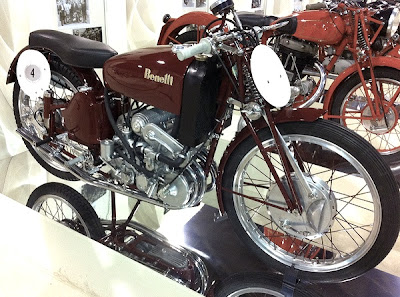
The 1940 Benelli 250-4 as it exists today
The gem of an engine designed by Giovanni Benelli produced in 1939 had a short stroke (42mm stroke x 45mm bore), with 12:1 compression pistons, and spun to 10,000rpm, at which point it cranked out 52.5hp, enough for 146mph on test runs - the fastest 250cc racer by a long shot, fully 16mph faster than their nearest rival, the brilliant supercharged 250cc flat-single from Moto Guzzi.  With such devastating performance (exceeding by 20mph the factory 500s of Norton and Velocette!), Benelli were confident of another European Championship, but the little 'four' wasn't ready for the 1939 racing season.  By the time the 'engine bugs' were sorted, it was 1940, and the competition was no longer playing nice.
The new 250cc double-overhead-camshaft four-cylinder Benelli racing engine, introduced in 1960
Lacking martial confidence in their native Italy, Benelli race chief Vincenzo Clementi stashed the entire racing fleet in rural areas away from Pesaro; purportedly their precious new 250cc 'four' had its engine hidden at the bottom of a dry well, while the chassis slept under a haystack, inside a barn. Their decision proved wise, as during 1940 and '41, Pesaro was bombed heavily; the Benelli factory had been converted to aero engine production (Daimler-Benz and Alfa Romeo types), and when the Allies advanced northward in Italy, all the precision machine tools were moved by the German army to more secure territory inside Austria and Germany.
The new Benelli '4' racer at the press launch in 1960
While the company returned to single-cylinder racers postwar (netting them a World Championship in 1950), by 1960 Benelli's line of small-capacity motorcycles was selling very well, and funds were allocated for the design of a new four-cylinder racer. Race chief Ing. Savelli and Giovanni Benelli designed an entirely new engine which bore resemblance to the 1938 design, but in truth, by 1960 a DOHC four with gear-driven cams had become the accepted pattern for a racing engine, having been developed by Gilera (from the original CNA/Rondine 'fours' dating back to 1926!), copied by MV Agusta, and then again by Honda, who won the 250cc World Championship title in 1961.  The new 'four' used a short stroke (40.6mm stroke x 44mm bore), a 6-speed gearbox, weighed 264lbs, and gave 40hp at 13,000rpm (oh, how supercharging was missed!  This was 12.6hp less than the blown 1939 design).  The completed machine was revealed with great publicity in June of 1960, but wasn't ready to race until 1962, and Silvio Grassetti had only one 'win' that year, at Cesenatico, but it sounded a bell at Honda, as both Jim Redman and Tom Phillis were bested on their Factory Honda 4s.  MV had withdrawn from 250cc racing the year before, to concentrate on retaining their 350cc and 500cc dominance.
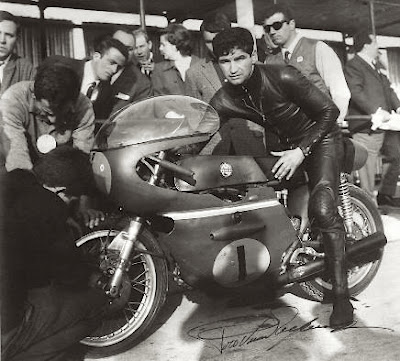
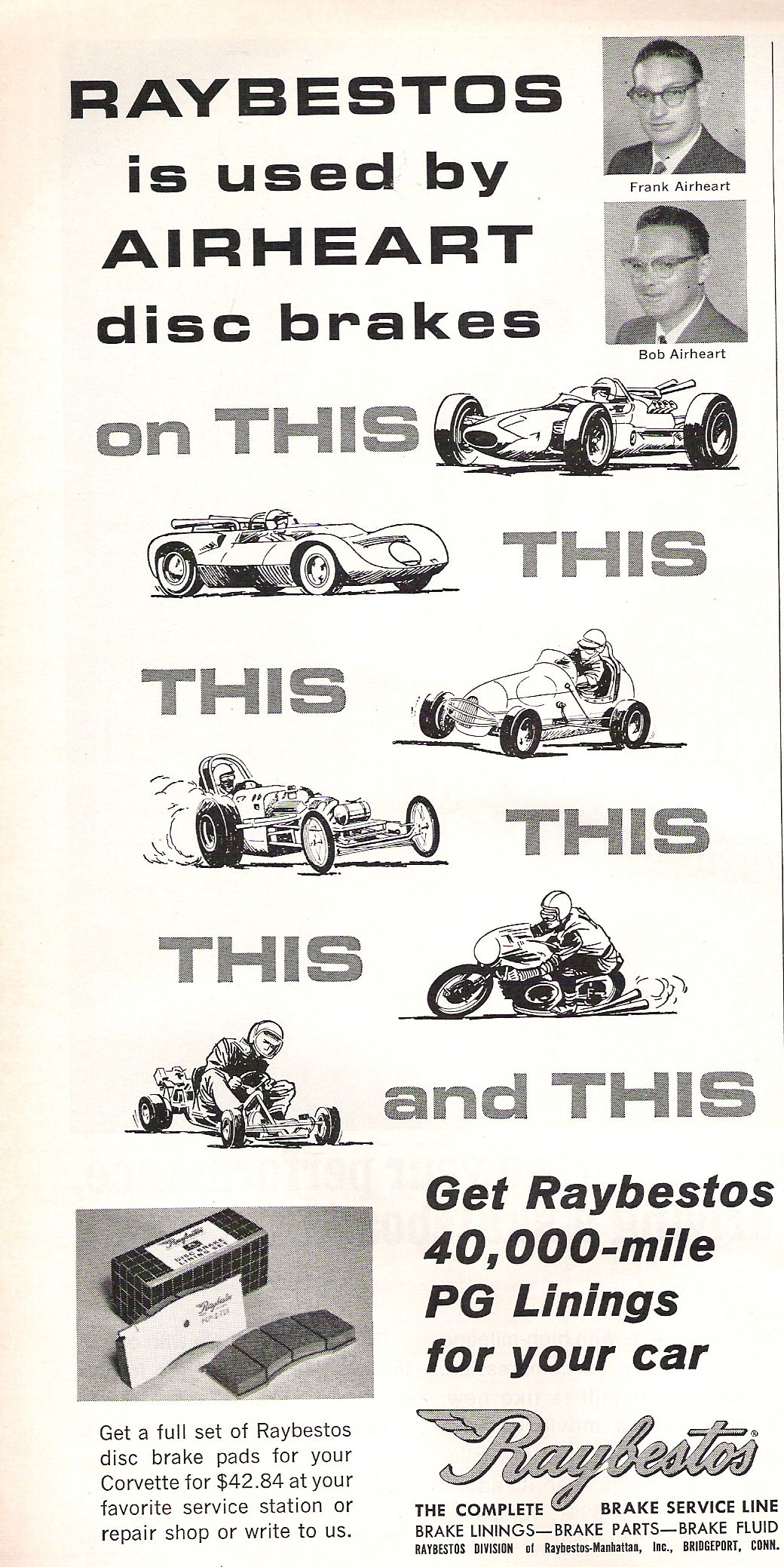
Tarquinio Provini on the 250cc Benelli 4 in 1965; note the 7" dual disc brakes.  These are American Airheart brakes from Go-Kart racers, and were possibly a first in GP racing, but proved inadequate on at 143mph, especially in the wet.  While the concept was sound, the brake pads hadn't yet evolved for serious high-speed use.  Benelli used them only in '65, retreating to reliable racing drums...
Tarquinio Provini, a veteran racing star with two World Championships, joined Benelli in 1963 to develop and race the new 'four'. He shortly increased power to 52hp at 16,000rpm, with a 7-speed gearbox, and 141mph top speed. A new frame lowered the center of gravity and pared weight down to 247lbs.  Years of ignition troubles with the high-revving engine were finally cured by fitting an American racing magneto...from a Mercury two-stroke boat engine. Provini won every race in the Italian championship in '64.  Benelli shocked the world by out-running the Japanese opposition at the super-fast Monza GP in 1965.
Provini hard at it in 1966
By '66, the Four had 8 gears, and a larger version with 322cc was introduced to compete in the 350cc GP events, going head to head with the 'big boys', MV Agusta, Honda, and Yamaha.    Provini had a bad crash at the Isle of Man TT that year, and injured his spine enough to retire from racing.  Benelli had never fielded a 'team' of professional riders who came and went with lucrative contacts; the family business had close bonds with the one or two racers they supported, and Provini's injury took the steam out of Benelli's race dep't for over a year.
The immortal 'Paso'; Renzo Pasolini
Benelli re-entered the racing fray with rider Renzo Pasolini, who won second place in both the 350cc and 250cc classes at the 1968 Isle of Man TTs, and dominated the Italian Championship in both classes the rest of '68, giving Giacomo Agostini and his MV and excellent view of the Benelli's tailpipes all year long.  In 1969, Kel Carruthers joined Pasolini, and the pair made an unbeatable team, each winning three GP victories that year, giving Benelli their second World Championship title.
Pasolini leaping Ballagh Bridge at the 1968 Isle of Man TT
Kel Carruthers joined Yamaha in 1970, but Pasolini took third place in the World Championship that year.  The Benelli family sold the factory and name to Alejandro de Tomaso, more famous for his automotive exploits than two-wheeled savvy, and support for developing the racers waned.  Still, Jarno Saarinen was hired in '72, and won his début races at Pesaro in both 350cc and 500cc classes.
Renzo Pasolini with Kel Carruthers
Both Saarinen and Pasolini left Benelli for '73 (for Yamaha and H-D, respectively), and Walter Villa became their #1 rider.  With horrific irony, Villa's 350cc Benelli was blamed for leaving a trail of oil during his race at Monza, which was then not cleaned up for the 250cc race, in which a multi-machine crash killed both Saarinen and Pasolini.  The details of the accident have been debated ever since, although it seems a catastrophic seizure of Saarinen's Yamaha (not an uncommon occurrence) may have led to the chain-reaction melée.
Kel Carruthers at the 1970 Isle of Man TT
Benellis interest in racing plummeted when new FIM rules limited 250cc racers to two cylinders and six speeds, which guaranteed an unstoppable rise of two-stroke racers, as their double-time combustion could only be opposed by outrageously sophisticated four-stroke engines, such as the Honda 6-cylinder, and the Benelli 250cc V-8 which was under development...which would certainly have put Benelli on par with Moto Guzzi as masterful creators of racing exotica.  The FIM, in their wisdom, preferred the crackle of two-strokes to a technical war of miniaturized-miracle racers, a decision which eventually killed Grand Prix motorcycle racing, and led to the birth of MotoGP.
Jarno Saarinen...with wife Soeli giving pit signals

Bonhams is selling a replica 350cc four-valve Benelli four-cylinder, of the type Kel Carruthers took to the World Championship in 1969, at their Jan 12 sale in Las Vegas.

November 28, 2011

A DAY WITH 'AGO'

Just in time for Xmas...Bench and Loom are offering a once-in-a-lifetime opportunity to ride with Giacomo Agostini, just you and him.  I can't afford it, but some lucky bugger can...why have a Steve McQueen replica whatever, when you can ride with a living treasure, one of the greatest motorcycling champions in history?
From the Bench and Loom website:

"Description
Giacomo Agostini is one of the greatest names in the history of competitive motorcycling.

He is the longest reigning champion of grand prix racing to have ever lived. For an astounding 30 years he held the title of the most successful racer of all time until the record fell to fellow Italian Valentino Rossi. With 122 GP wins (including 10 Isle of Man TTs) and 15 World Championships, Agostini’s name is synonymous with victory.

His celebrity status obliges his presence at various international racing celebrations each year, and an admiring crowd is found everywhere he goes. Yet despite his demand, this legend of motorsport does not coach race teams or teach riding courses. Instead, Ago (as he is affectionately known by his legion of fans) chooses to spend his time in privacy with his family in Europe.

Available through Bench & Loom is an exclusive, once-in-a-lifetime opportunity to spend a day privately riding with Agostini. Choose between a racetrack or quiet back roads in either California or Spain. The day can be spent one-on-one or with up to four of your friends. The choice is yours. 

Price
$30,000 Spanish back roads
$50,000 Spanish racetrack (Jerez, pending availability)
$35,000 California back roads
$55,000 California racetrack (Monterey, pending availability)
"

June 3, 2011

100 YEARS AFTER THE 'INDIAN SUMMER': OLIVER GODFREY

The final chapter in a special series for The Vintagent commemorating the victorious Indian team at the 1911 Isle of Man TT, the winner Oliver Godfrey.   Compiled by the authors of 'Franklin's Indians' and Chris Smith of Motorsport, and edited by Paul d'Orléans:
Godfrey aboard his winning 1911 TT Indian
Oliver Cyril Godfrey was born in London in 1887 to an artist father, a painter and engraver, who decamped to Australia before 1901.  Mrs Godfrey eventually remarried, and as late as his 1911 TT win, he was still living at his mother and step-father's home in Finchley, employed as a 'motor spindler' (ie, machinist).  By this time, young Oliver was a dedicated racing motorcyclist, and began racing at the Isle of Man by the age of 19, first on 726cc Rex twins in 1907 thru '09, then the ubiquitous Triumph single-cylinder in 1910. He at last won the TT in 1911, on his fourth attempt, and raced on the Island until 1914, but didn't get far in 1912, when mechanical trouble at the start line put paid to dreams of a second win.  All his TT appearances from 1911 onwards were aboard an Indian. 

Godfrey at the finish of the 1911 Senior TT
Godfrey was one of five riders supported by the Indian factory to enter the 1911 TT, the other riders being a mixture of English, Irish, Scots and American in the form of Arthur Moorhouse, Charles Franklin, Jimmy Alexander and Jake De Rosier respectively; all these riders are profiled in The Vintagent. The Indian team was managed by UK Indian concessionaire Billy Wells of the Hendee Mfg Co.’s London branch, and “technical advisor” was the great Medicine Man of Indian himself, chief engineer Oscar Hedstrom.
Godfry and his Indian at Brooklands, 1911
Given the unpaved, country roads which comprised the Isle of Man TT course in those days, falls over the dirt, mud, and stones were common; both de Rosier and Alexander had significant crashes in 1911, yet Godfrey rode consistently and well to finish the race without a fall, just ahead of Charlie Collier (Matchless) who was second to cross the finish line. CB Franklin similarly had a straightforward race, and Moorhouse, although he did fall off once, kept his place on the leader board.  Collier had misjudged his gasoline consumption and was forced to take on fuel at an unauthorised filling point, and was disqualified, which elevated Franklin and Moorhouse to 2nd and 3rd places. 
Godfrey just after the 1911 TT win, escorted by Billy Wells and Julia Hedstrom
Godfrey’s winning feat established a number of “firsts”, including the first ever '1-2-3' clean sweep by a factory team, first TT win by a foreign manufacturer (Indian), first Senior TT win, first win on the new 'Mountain' course over Snaefell mountain (the same course used today), and first Mountain course Race record (though Frank Applebee’s Scott set the first Mountain course Lap record). In a rather upbeat TT race report reprinted in the 1912 Indian UK sales catalogue, Godfrey was described as “small in size, but a bunch of muscles and nerves and a magnificent rider”.
Godfrey at the 1914 TT
Godfrey failed to start in the 1912 TT, “Did Not Finish” in 1913, but was able to claim 2nd place in the 1914 Senior TT.  His Isle of Man record and results at the Brooklands Track in Surrey place him at the forefront of motorcycle racers pre-World War One.  Godfrey was a business partner with 1912 Senior TT winner, Scott-riding Frank Applebee, in Godfreys Ltd, motorcycle retailers located at 208 Great Portland Street, London W1. This firm continued trading until the 1960s. A 1920 magazine advertisement laid claim to experience in all aspects of the motorcycle trade “including winning the 1911 and 1912 TTs”.  Certainly a rare attribute!
Godfrey's 1916 flying certificate from the RAC; he was 29 years old.
When war against Germany was declared in 1914, Godfrey enlisted as a pilot in the Royal Flying Corps. He earned his Royal Aero Club Aviator's certificate in a Beatty-Wright bi-plane at Hendon (now a massive RAF museum) in January 1916. The RFC used the Royal Aero Club for pilot certification through WWI, training about 6300 pilots during the War. In the photo above,  from Godfrey's flying certificate, the wires behind him are likely wing-wires on his Beatty training bi-plane.
The Martinsyde G100 'Elephant'; slow and unwieldy
Oliver Godfrey was posted to 27 Squadron of the Royal Flying Corps which first arrived in France in March 1916 and by June was based at Fienvillers, 10 miles west of Albert in the Somme Valley, and 15 miles behind the front lines.  Their “base” used a cow pasture for a runway, where the fliers and ground-crew all slept in tents. The squadron was equipped exclusively with single-seater fighter scouts, the Martinsyde G100, nicknamed the 'Elephant' as it was big and responded slowly to pilot input.  Unsuitable as a fighter, the 'Elephant' had a long flight range, so was redeployed as a bomber and reconnaissance scout, and flew missions up and down the western front, to Bapaume, Cambrai and Douai. 
A Martinsyde 'Elephant' in a muddy airfield...
The bombing success of 27 Squadron became their main role from 9 July 1916 onwards, and enemy airfields at Bertincourt, Velu and Hervilly were added to the list of targets. Oliver Godfrey joined the Squadron at this point, a relatively easy period for British fliers, when the chances of survival were still reasonable. The start of the Third Battle of the Somme on 15 September saw the squadron attack General Karl von Bulow’s headquarters at Bourlon Chateau, followed by more bombing of trains around Cambrai, at Epehy, and Ribecourt. By August 1916 the German Imperial Army Air Service was reorganized, and new “hunter” squadrons were created, becoming the pioneers of specialist fighter aircraft formations and tactics (the 'Dicta Boelke'), soon to be universal. The first 'hunters' were Jagdstaffel 2, formed at Lagnicourt, under the command of Oswald Boelcke, Germany’s top-scoring pilot at the time, and a young Manfred von Richthofen (the 'Red Baron') was among pilots hand-picked by Boelcke for the new unit, and by 16 September Jagdstaffel 2 had received enough of its allotted aircraft to commence operations in earnest. 
The Hunter: Manfred von Richthofen sitting on a downed Martinsyde 'Elephant'
For RFC units like 27 Squadron, their 'honeymoon' in France was definitely now over. It was during a bombing mission by six Elephants to Cambrai on 23 September that Oliver Godfrey lost his life, most likely shot down by Hans Reimann of Jadgstaffel 2, who was himself killed in the same engagement. The events of that day are described in a history of 27th Squadron written by Chaz Bowyer:
"On September 22nd bombing raids were carried out on Quievrechain railway station. One pilot, seeing that his bombs had failed to explode, proceeded to strafe the engine driver of a train attempting to leave the station quickly. Later in the day, fifty six 20lb bombs were scattered in Havrincourt Wood, suspected of harbouring German infantry. The following day 27 Squadron sent six Elephants on an Offensive Patrol over Cambrai, setting out at 8.30 am. All six were attacked over Cambrai by five Scouts of Jagdstaffel 2 led by Boelcke in person - with disastrous results for the Martinsydes. Sgt. H. Bellerby in Martinsyde 7841 was shot down almost immediately by Manfred von Richthofen (his 2nd official victory) while within seconds two more Elephants piloted by 2/Lts. E.J. Roberts and O.C. Godfrey were destroyed by Leutnants Erwin Boehme and Hans Reimann. Recovering from the shock of the first German onslaught, the remaining three Martinsydes continued the fight despite being outnumbered and outclassed by superior German aircraft. Lt. L.F. Forbes having exhausted all of his ammunition made one last defiant gesture by deliberately charging at the Albatros piloted by Hans Reimann, ramming the German scout in a near head-on collision. Reimann spun to earth and his death in a crushed cockpit, but Forbes, in spite of one collapsed wing with aileron controls shattered, managed to nurse his crippled Martinsyde towards base."
A Martinsyde downed behind German lines...
Godfrey had only been in France 3 months, and was one of 252 crew and 800 planes lost during this 4+ month campaign, in which the RFC lost a staggering 75% of its men in the battle...yet on the ground it was far worse, with 750,000 dead in an evil Autumn. Many of the pilots coming to France at that time were relatively inexperienced, deployed to replace downed airmen as fast as they could push them out of the training schools.  German pilots, with vastly superior aircraft and plenty of tactical combat experience as the months went by, racked up hundreds of 'kills', before the tide of the war turned, and they in turn became the hunted.
The Hunted: von Richthofen's plane after being shot down on Apr 21, 1918
When Godfrey was shot down, Cambrai was situated miles behind enemy lines, and its unclear what became of his body or whether, indeed, there was anything left in the burned-out wreck to bury. His memorial is Ref. IV. F. 12. at Point-du-jour Military Cemetery, Athies, near Arras. On settling his estate some 18 months later, the small fortune of £1475 went not to his mother, but to Frank Applebee, Scott-mounted winner of the 1912 TT and Oliver’s business partner in Godfrey’s Ltd, the motorcycle dealership in London which carried its founder's name nearly 50 years after lying down in the green fields of France.

'Franklin's Indians' is now available in the US at Motorsport Publications and the rest of the world at Panther Publishing Ltd.

Related Posts Plugin for WordPress, Blogger...
Twitter Delicious Facebook Digg Stumbleupon Favorites More

 
Design by Free WordPress Themes | Bloggerized by Lasantha - Premium Blogger Themes | Best WordPress Web Hosting