Showing posts with label Steam Cycles. Show all posts

January 17, 2012

LAS VEGAS 2012: AUCTIONS AMERICA (RM)

Star of the show - star of the whole weekend actually - the 1895 Roper Steam Velocipede, one of the oldest motorcycles made in America, and Roper's second motorcycle; his first sits in the Smithsonian Museum, and is the oldest motorcycle in the world at 1867...a title shared with the Perraux steam cycle of France, built the same year.
The condition of the Roper is phenomenal.  While it has lost its asbestos cladding of the burner box, the motorcycle is otherwise complete and original, having passed from Roper's son to a museum, then a private owner.  Read the story here.
Alas, it went unsold at the auction; rumor has it that RM owns this machine, purchased for ~$500k. 
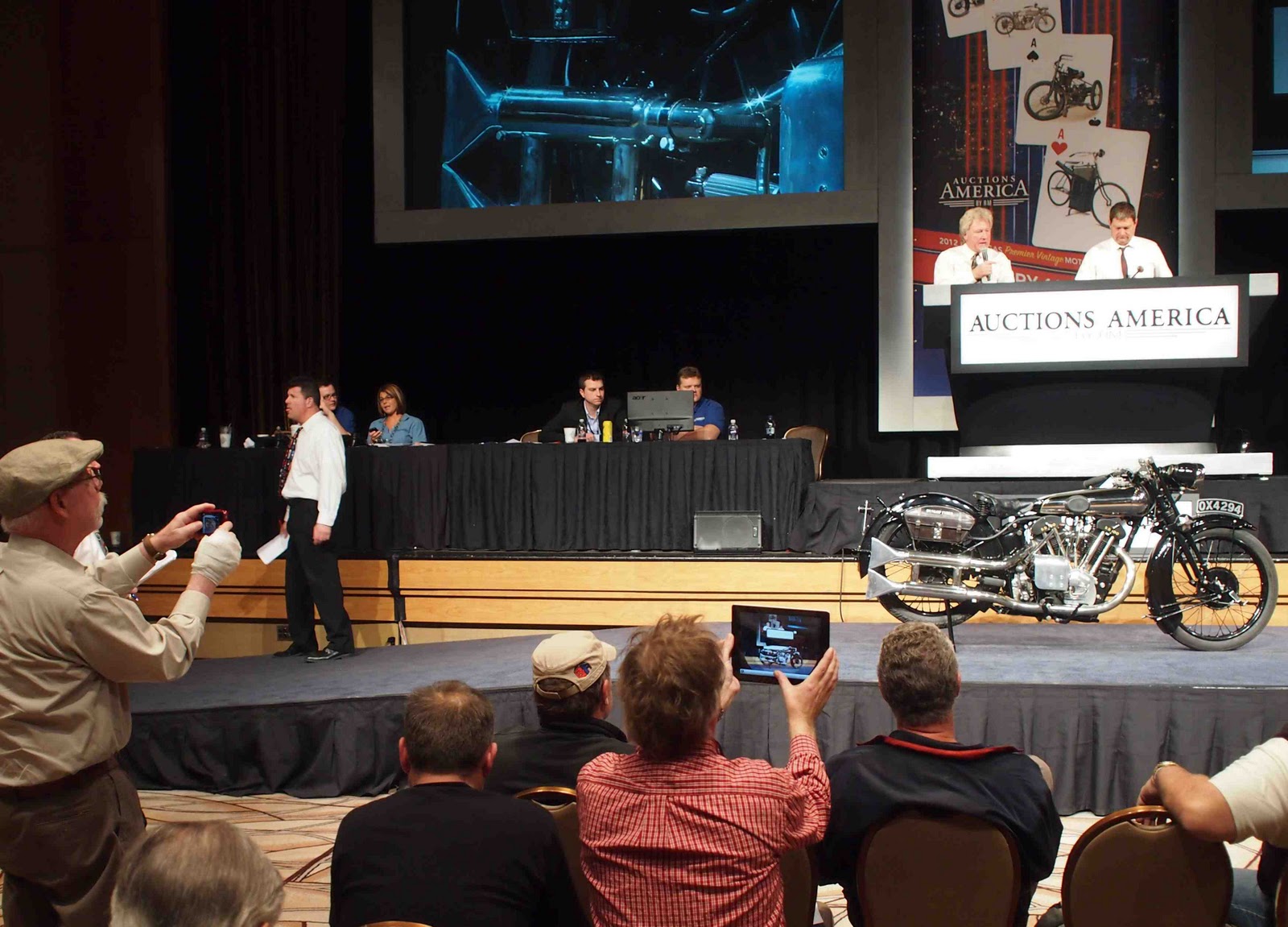
The 1928 Brough Superior SS100 'Dunlop' bike attracted a lot of interest, but not enough to meet reserve...
Another favorite; an original paint 1929 Cleveland 'Tornado' 4-cylinder, a real hotrod in the day, capable of over 100mph, and beloved of police forces lucky enough to use them!  Also unsold...
Racers!  A 1959 AJS 7R ($39,200) and cool Norton dustbin
Auctions America consigned a large Cotton collection, this one from 1928, with a 350cc Blackburne engine'...
The Blackburne engine in question...
...plus a groovy cast-aluminum 'Cotton' silencer.
Will six be enough for you, sir?  The Benelli 750 Sei..

This is not camera distortion; the largest tank ever on a '63 Cotton Conquest

1899 De Dion / Peugeot trike...just like they race them in England.  That's right; never let it be said valuable old bikes are left to languish in collections - the best owners use them! Alas, unsold...

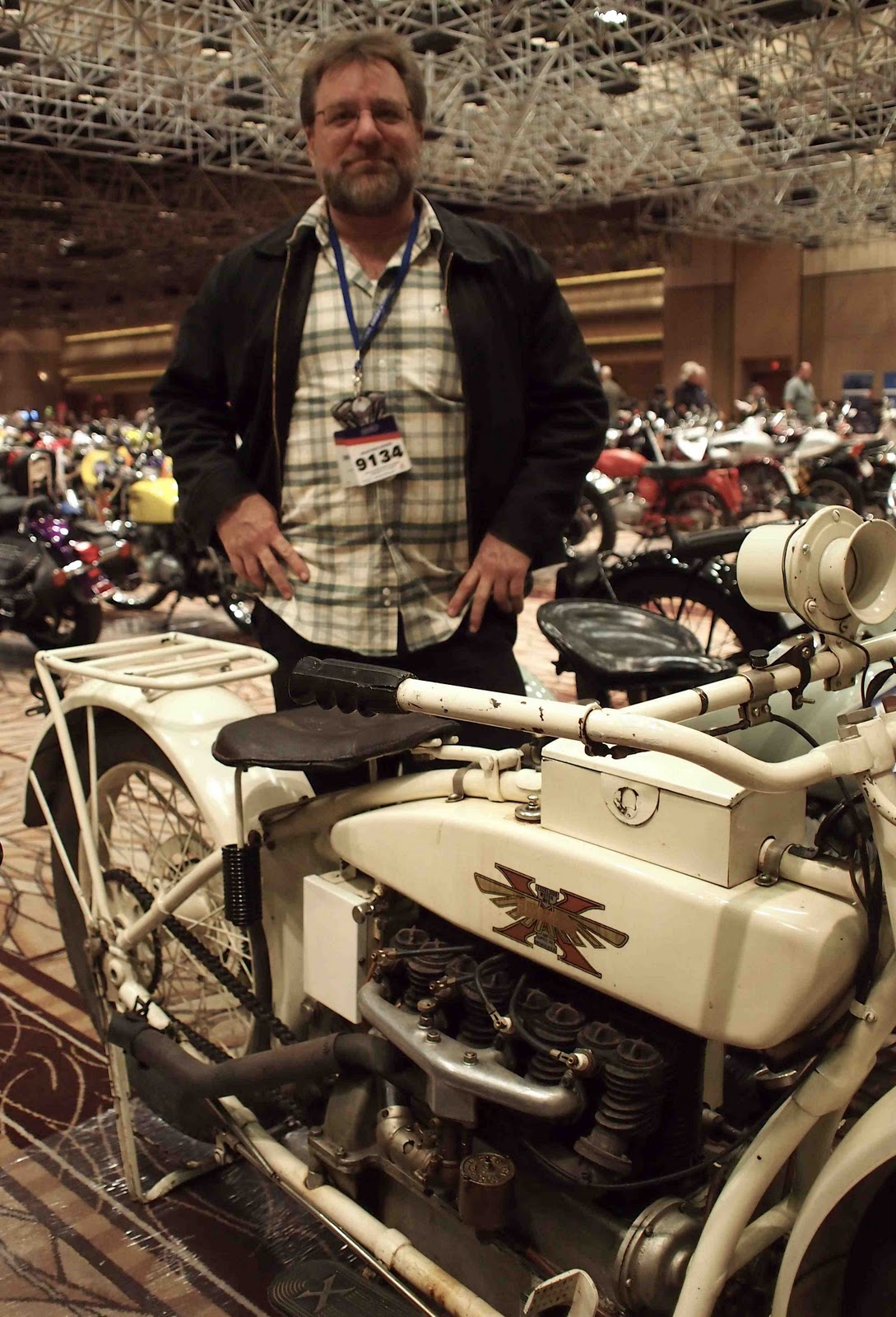
After purchase, Clay mentioned not liking the white of this Excelsior 4-cylinder..."But all the rest are blue!" I noted, and he felt better about his 'ghost' machine.

Great period details, great patina...

Auction America's Glenn Bator with an 1925 HD Board Track Racer...

The hall at the Rio casino, plenty spacious for 700 or so bikes...

Glorious 1913 Henderson Model B, an older restoration, with just enough use to give it an appealing patina.

Business end of a one-off jet bike, with an 317hp from its Allison turbine...

...this is not Allison Turbine...

Not enough dustbins these days; it was a pleasure to see this one ready for the track...

...and even better from this position!  Norton Manxes with such fairings are rare...

Sweet Rickman-Triumph, already in the van...

This ex-Steve McQueen, Von Dutch pinstriped Scott Squirrel is the sister of one which sold for $276,000 and sits on my 'Top 20' at Auction list...but this one failed to sell.


Winner - best transfer.  The Tehuelche 75cc ohc single-cylinder racer, from Argentina...

...with a lovely little engine, and a train of gears to the top.


A second Cleveland Tornado, this one restored.  Also failed to sell...

Greg recognized what was advertised as a '61 Triumph Bonneville, to be in reality a matching-numbers 1959 model, far rarer, and felt he got a bargain at $3500...

Vicki Smith with what she knows best; Ducatis

The 1902 (or maybe '04) Whitley of Coventry, the only known example, and in original paint.  Sold for $44,800

Two HD XR750 flat-trackers passed over the auction block...

Brett Robinson and the HD Panhead he felt was a bargain at $15,000...nice to see some fresh faces at Las Vegas!

November 14, 2011

FIRST DEPICTION OF A MOTORCYCLE?

The Science Museum print from 1818, depicting a German 'Vélocipédraisiavaporianna'
While researching the history of early motorcycle advertising (subject of an upcoming article in the French Café Racers magazine), I ran across this 1818 sketch of a powered two-wheeler in the London Science Museum, the first such depiction of a proto-motorcycle I've come across.  Called, cheekily, the 'Velocipedraisiavaporianna', the pictured machine is a conjunction of the world's first steerable two-wheeler, the 'Laufsmachine' (or 'Draisine' in France), and a small steam engine with a small army of stokers and fuel-carriers following behind. Parsing the title, a 'Velocipede/Draisia' meets the 'vaporianna', or steam engine. If the 1818 attribution of this French print is correct, this vehicle was remarkably conceived only a year after the two-wheeler was invented, in a world with no electronic media.  A close look reveals two pipes with shut-off valves leading from the large boiler box, one to each wheel.

The steam petcocks and pipes are clear, as is the implication of a hub-drive steam turbine...
While the wheels are insufficiently detailed, steam leading to the wheel hubs would imply a pair of small turbines in the hubs...which would not have sufficient torque to move a heavy machine from a standstill, but would give a useful boost once moving, perhaps even enough to propel the machine without assistance. The principles of steam boilers and turbines were well known by 1818, and the first powered vehicle, Cugnot's steam tricycle, had been demonstrated 60 years earlier.

The idea is clear; an engine could power two wheels, and even if this sketch is notional, the concept of the motorcycle was born.
An 1820 version of the Laufmaschine, with steerable front wheel
 Karl Drais invented his 'Laufmaschine' (running machine) in Mannheim, Germany, in 1817, and word (plus copies) of his invention spread rapidly, with the new machine called the 'Draisine' in France, the 'Velocipede' in England, and the 'Dandy Horse' (likely due to 'riders' being the well-heeled sort; new technology is always expensive...).  Drais may have been inspired to refine a 'horse substitute' as a result of a serious famine in Europe in 1816, the 'Year Without a Summer', in which disastrous climatic changes from the largest volcanic eruption in 1300 years, of Mount Tambora in Indonesia, spelled doom for expendable livestock, which included horses.  Necessity is the mother of invention, and Europe's hunger planted the root stock of all two-wheelers to come.
Hats off to Karl; we're nearing the 200th birthday of his invention.

April 21, 2011

ROPER STEAM VELOCIPEDES

Roper's Steam Velocipede of 1867, now at the Smithsonian
Sylvester H. Roper invented the motorcycle in 1867, in Boston, around the same time Messr's Michaux and Perreaux also invented the motorcycle, in Paris.  Each of these inventions was created independently, and as small, light, portable steam engines were almost nonexistent at that date, each required the creation of its own motive power unit.  These are remarkable achievements with no historic precedent, barring the very first powered vehicle of all, the Cugnot steam tricycle, built a century prior to either Steam Velocipede. Technology progressed slowly in the 1700s!
Roper with his first Steam Carriage of 1863
Sylvester Roper, born in 1823, was a singularly brilliant individual, patenting sewing machines, machine tools, furnaces, shotguns, fire escapes, as well as building his steam-powered two, three, and four-wheelers, which he did not patent.  His Steam Velocipede was created a few years after building his first Steam Carriage (ie, automobile) in 1863, in the midst of America's Civil War, while he was stationed at the Springfield Armory.

His first Velocipede of 1897 used a very small steam engine, which Roper built himself. The engine was suspended from a forged iron frame -purpose-built for the machine- on spring steel strips, which absorbed many of the road shocks typical of the 'boneshaker' bicycle chassis.  The front fork was also iron, and wheels were wooden with steel 'tires', 34" in diameter; water for the boiler was carried inside the rider's saddle!  The engine had two pistons of 164cc capacity, each connected by a crank-arm and rod to the rear wheel.  The total engine capacity was 328cc.
Roper's patented Repeating Shotgun
The rider controlled his Velocipede by rotating the handlebars forward - and thus the twistgrip throttle was born, decades before Glenn Curtiss claimed the same with his first motorcycles, which was again before Indian received general credit for this excellent idea!  To stop the Roper, the rider rotated the handlebars backward, which pressed a steel 'spoon' onto the front wheel.  Water was automatically fed from the seat to the boiler via a water pump actuated by engine rotation. The small firebox at the bottom of the motor was fed with charcoal, and a pressure gauge mounted on the steering-head kept the rider apprised of power, and danger.
Roper with another of his Steam Carriages, ca.1867
The contraption worked, although perhaps not as well as his Steam Carriages, which had space for much larger engines, and carrying capacity for water and fuel, which meant a longer travel range.  The harsh ride of the wooden wheels with steel tires must have become tiresome as well, in contrast to his four-wheelers which used buggy springs for rider comfort...Roper postponed work on his Velocipedes for 15 years.

Drawings for the second Steam Velocipede
In the intervening years, bicycle design had undergone a sea change, as in 1880, the Rover Safety Bicycle was invented, and rubber tires came into general use.  These improvements must have spurred Roper to take up two wheels again in 1894, when Albert Augustus Pope commissioned Roper to make a new Steam Velocipede using a modified version of Pope's popular 'Columbia' safety-bicycle frame, with pneumatic 'Dunlop' tires.   The intention of Pope (who by 1911 manufactured his own motorcycles) was to use the machine as a cycle-pacer on the incredibly popular bicycle racing velodromes of the day.

Roper with his Steam Velocipede in 1895/6
 Roper designed a new steam unit weighing about 125lbs, making an all-up weight of the machine 150lbs. The bump absorption capacity of air-filled tires made it possible to solidly mount the engine to the frame, in the 'right' location, with the weight low and centrally between the wheels.  A single cylinder and piston of 160cc drove the bicycle via a long connecting rod, and a short crank at the rear wheel. Steam pressure was kept between 160 and 225psi (for hills), although the engine was tested to 450psi. The machine was good for at least 40mph, and carried enough coal for a 7-mile trip.
The new machine was compact, light, and very fast, and Roper, pleased with his results, put in quite a few miles on his steamer, regularly riding a round-trip of 7 miles between his home in Roxbury to the Boston Yacht ClubAmerican Machinist magazine noted, "the exhaust from the stack was entirely invisible so far as steam was concerned; a slight noise was perceptible, but not to any disagreeable extent."
The 1895 Roper Steam Velocipede, currently in private hands.
Roper was happy to demonstrate his steam vehicles to the public, at fairs and exhibitions, and claimed his latest Velocipede, or 'Self Propeller' as he called it, could "climb any hill and outrun any horse."  On June 1st, 1896, he rode to the Charles River Speedway in Cambridge, to show the local bicycle racers his new cycle-pacer.  Several cyclists agreed to keep pace with him on the banked 1/3 mile cement track. The Boston Globe of June 2 reported, "The trained racing men could not keep up with him and he made the mile in two minutes, one and two-fifths seconds.  After crossing the line, Mr.Roper was apparently so elated that he proposed making even better time and continued to scorch around the track.  The machine was cutting out a lively pace on the back stretch when the men seated near the training quarters noticed the bicycle was unsteady. The forward wheel wobbled badly...", and it seems track-side viewers rushed out to catch the slowing rider, who had died of a massive heart attack, while riding at age 73.  As Roper controlled the throttle with a cord around his thumb, steam power shut down as he relaxed into the arms eternal night, having proved himself the first motorcycle Speed Merchant.
Roper's son Charles, wheeling the Steam Cycle from the Cambridge track after his father's death.
Both of Roper's Steam Velocipede exist; the First Motorcycle is on permanent display in the Smithsonian Museum, the second is privately held, originally in the hands of Roper's son Charles.  It is rumored this machine will soon come up for sale...watch this space.

For an educational look at what it takes to build a steam cycle, visit the Flash Fabrications website!

April 7, 2011

STEAM CYCLES AND HISTORY

The Roper Steam Velocipede of ca.1867
While we think of History as immutable and as reliably solid as the configuration of hydrogen atoms, the 'truth' of our past is constantly shifting, as our individual or collective attitudes move from established belief sets to new paradigms, in which the interpretation of history, and indeed the very 'facts' of events, are seen in totally a new light, and our historic priorities are re-ordered [1].
Patent drawing for the Michaux-Perreaux Steam Velocipede of 1869
A paradigm shift in our view of motorcycle history is imminent, as alternatives to the internal combustion engine come to the forefront of technology, grow into general use, and are understood as the logical, even moral alternative to the vast political/economic/military structure hardened around the discovery, ownership, and distribution of fossil fuels.  History may well view our current troubles in oil-producing lands the economic equivalent of the Crusades, with oil the motivating 'religion'; it is inconceivable to oil-hungry nations that unfriendly hands control the source... regime change and war are thus justified.
The Mission One electric sports motorcycle.
As electric and alt-energy vehicles -including motorcycles-  come into general usage, the importance of their historic forbears is greatly magnified, and the first attempts at powered travel are seen in a new light.  Thus it is with the Steam Cycle.  Dismissed as a vestigal dead-end, nearly irrelevant to the history of Motorcycling, the very first powered two-wheelers in history have not been give their proper place in the family tree.  Indeed, my copy of the Oxford English Dictionary defines a Motorcycle as having 'an internal combustion engine' [2], which is simply ridiculous, given the great strides in electric motorcycling the past few years, and the TTXGP highlighting the viability of sporting battery power.
The Roper Steam Velocipede
Using a more generous definition of a Motorcycle, 'two wheels with a motor', the very first Motorcycles (then called Velocipedes) were built ca.1867-9.  Tied for this distinction are two steam-engine two-wheelers, one built in the USA by Sylvester Roper, the other in France by Louis-Guillame Perreaux and Pierre Michaux [3]. The two machines were both built around contemporary-pattern 'bone shaker' chassis, although each machine appears to have used a purpose-built frame between the wheels to adapt the engine.  The Michaux-Perreaux used a steel frame with the engine above the rear wheel, the Roper used a forged iron frame, with the engine suspended beneath.  Each machine deserves its own post, so I will oblige with more details later, after visiting the velocipedes in person (the M-P lives in the Musée de l'Isle de France, just outside of Paris, the Roper is in the Smithsonian).
The Michaux-Perreaux Steam Velocipede
These are the true forbears of every Motorcycle, and each is a remarkable testament not only to the ingenuity of their inventors (these small, portable steam engines were among the very first of their kind), but as well, the impulse, as yet unnamed, to ride a motorcycle.  They knew it was going to be good, and they were absolutely right.
The last development of the Roper Steam Velocipede, 1895
While the Michaux-Perreaux appears to be unique as a two-wheeler (they did, in 1884, build a 3-wheel version), Sylvester Roper went on to build another Steam Velocipedes, developing and refining the concept, perfecting his portable steam engine, making changes to his chassis. His last design of 1895 (above), was sponsored by the Pope Manufacturing Co., and used a modified Pope 'Columbia' safety-bicycle frame, the old 'bone-shaker' bicycle design having been modernized with steel tubes and rubber tires - and wheels of equal size were far 'safer' than the 'penny farthing' bicycle. This last Roper Steam Velocipede survives, remarkably, in private hands, about which more in my next post.
The Michaux-Perreaux at the Guggenheim's Art of the Motorcycle exhibit.
The Michaux-Perreaux appeared on the floor of the Guggenheim Museum for the seminal 'Art of the Motorcycle' exhibit, the first motorcycle confronting viewers as they entered, and to the show's 300,000 visitors, the charming little vehicle was complete news. Kudos to the curators for bringing this machine to light, to New York, and to the public consciousness as the First Motorcycle.  It's my understanding  the Roper was also meant to occupy the entrance, but the Smithsonian wanted a very substantial cash bond for the loan of what it rightly considers a priceless artifact of human history... thus the M-P stole the floor show, and now occupies a greater part of popular opinion as The First.  Such is the whim of chance, altering History...again.


[1]: For more on the subject, see Thomas Kuhn's 'The Structure of Scientific Revolutions'.
[2]: Even Cycle World's esteemed Kevin Cameron has argued that only the I-C engine counts as the true root of modern motorcycling, as "History follows things that succeed, not things that fail" (the statement itself a highly debatable claim on History!), while LJK Setright preferred to use the term 'heat engines', which includes steam, but excludes electric motoring.  Recent and online versions of the OED use 'two wheels and a motor, without pedals' - which excludes most motorcycles of the 1900s-20s, which HAD pedals!
[3]: There is much debate about exact dates on each of these machines; for this article, I call a tie, not having time to search the records for my own opinoin.  M-P patented his velocipede in 1869, but Roper's machine seems to have appeared in 1867, although Roper never patented his steam vehicle designs.

Related Posts Plugin for WordPress, Blogger...
Twitter Delicious Facebook Digg Stumbleupon Favorites More

 
Design by Free WordPress Themes | Bloggerized by Lasantha - Premium Blogger Themes | Best WordPress Web Hosting